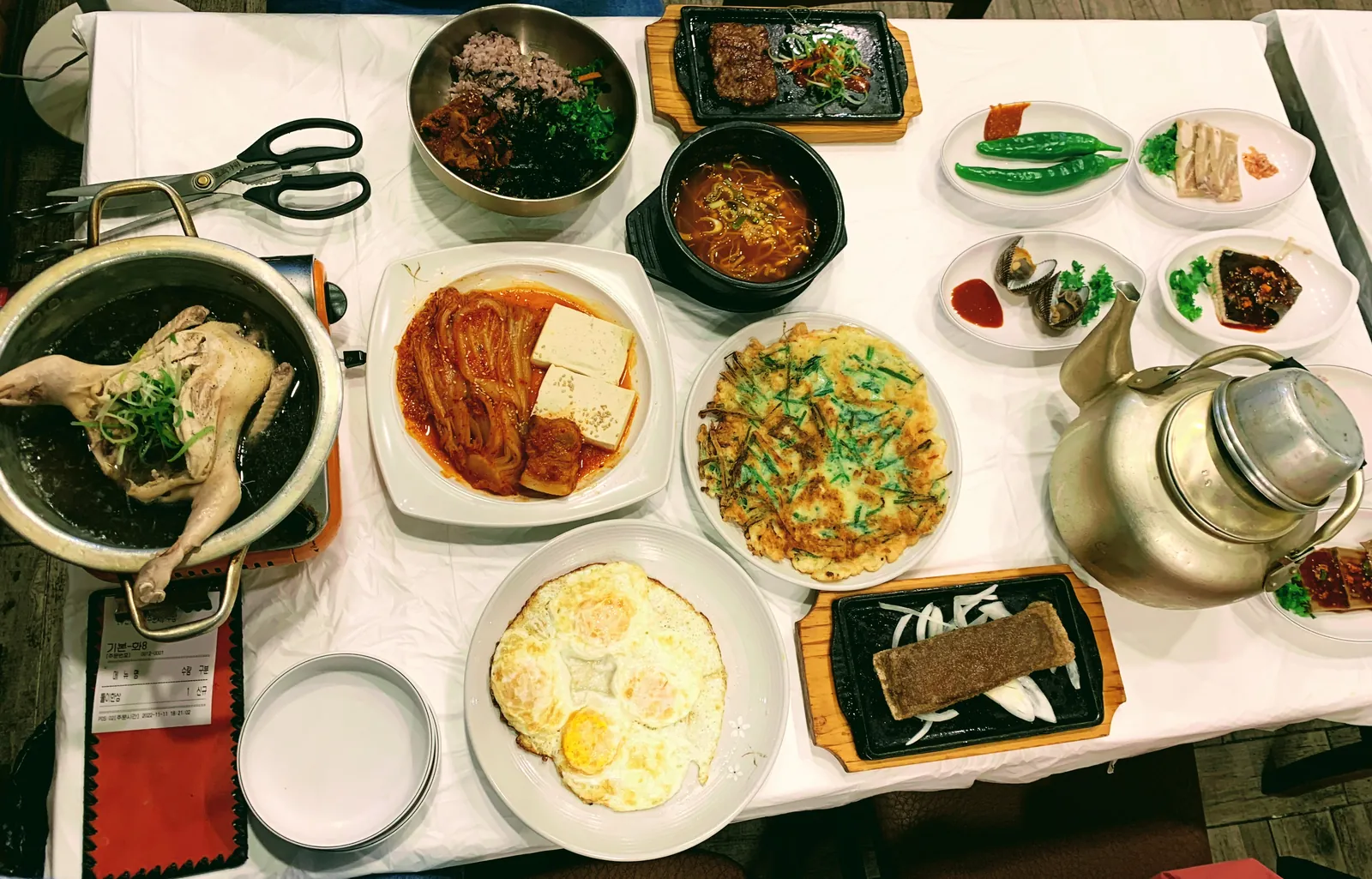
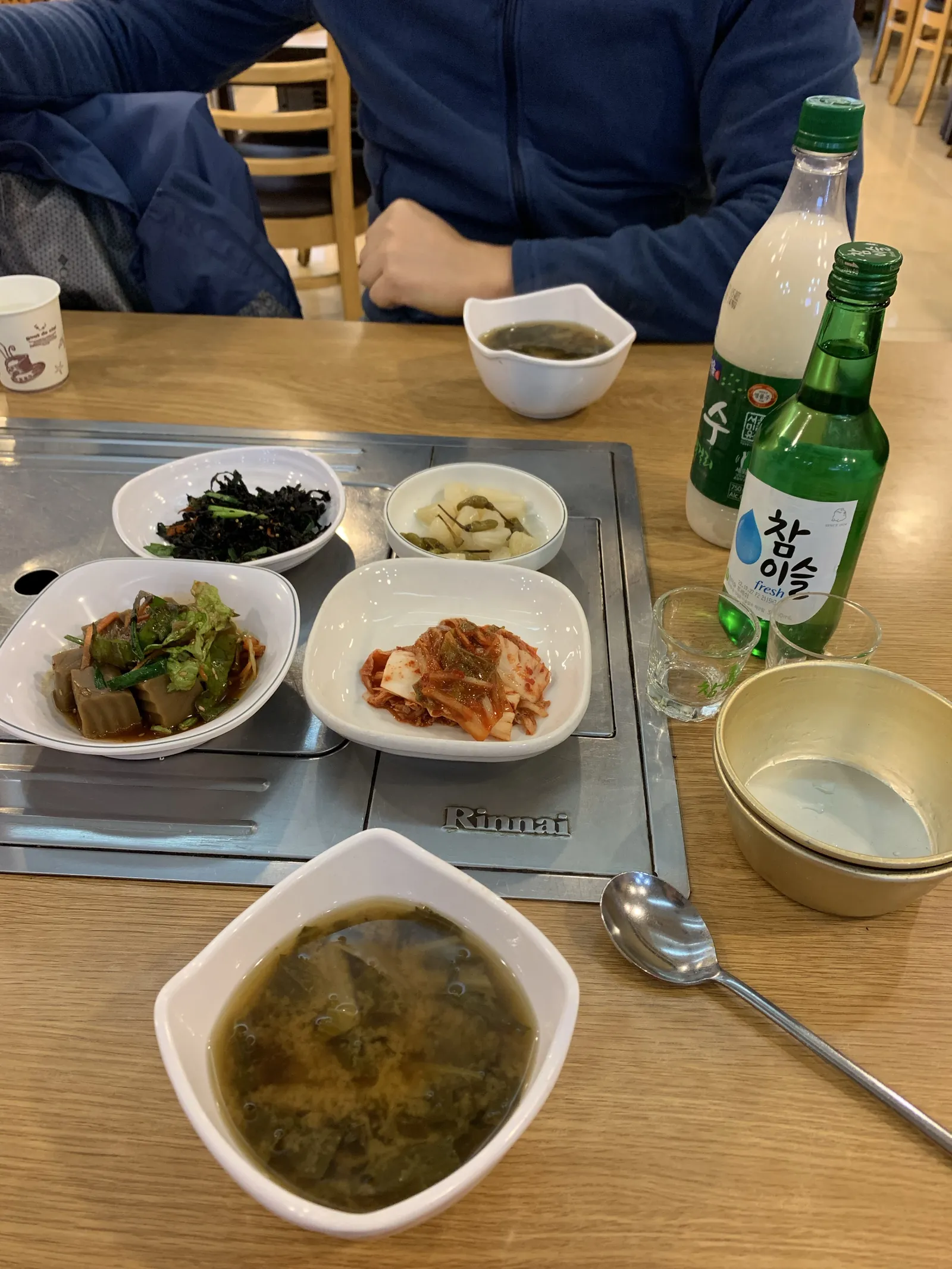
In Korea, food isn’t just food — it’s a social ritual, the glue of community, and the fastest route to the heart of the country’s culture. The first time you sit down at a restaurant table and five or six little dishes of side dishes you didn’t even order appear in front of you, you realise: here everything works differently, and that’s a very good thing.
Some links in this article are affiliate links. If you book through them I earn a small commission, at no extra cost to you.
Contents
- Seven dishes you must try
- Bibimbap — all of Korea in one bowl
- Samgyeopsal — BBQ you grill yourself
- Tteokbokki — the spicy king of street food
- Kimbap — the travel sandwich
- Mandu — Korean dumplings
- Bulgogi — marinated beef, tender and sweet
- Bibim naengmyeon — refreshment on a hot day
- Fermented dishes
- Kimchi — not a side, but a foundation
- Doenjang jjigae — the soup that feeds the soul
- BBQ culture and banchan
- Grilling at the table
- Banchan: the free side dishes
- For vegetarians: temple cuisine and reality
- Temple cuisine — the purest alternative
- Practical difficulties
- Street food: markets and night markets
- Gwangjang market — the first encounter
- Myeongdong and night markets
- How to order and pay in a restaurant
- Ordering
- Paying
- Where to find good places: markets, locals and apps
- FAQ
This guide is here so you know what to eat, where to look for the best places and how to behave in a restaurant — without any trouble and without going hungry. If you’re still just planning the trip and want the bigger picture, start with the South Korea traveller’s guide.
Seven dishes you must try
Korean cuisine is broad — fermented, spicy, fried and stewed. But there are a few classics without which the trip stays unfinished. Start with these, and then let your appetite lead you on.
Bibimbap — all of Korea in one bowl
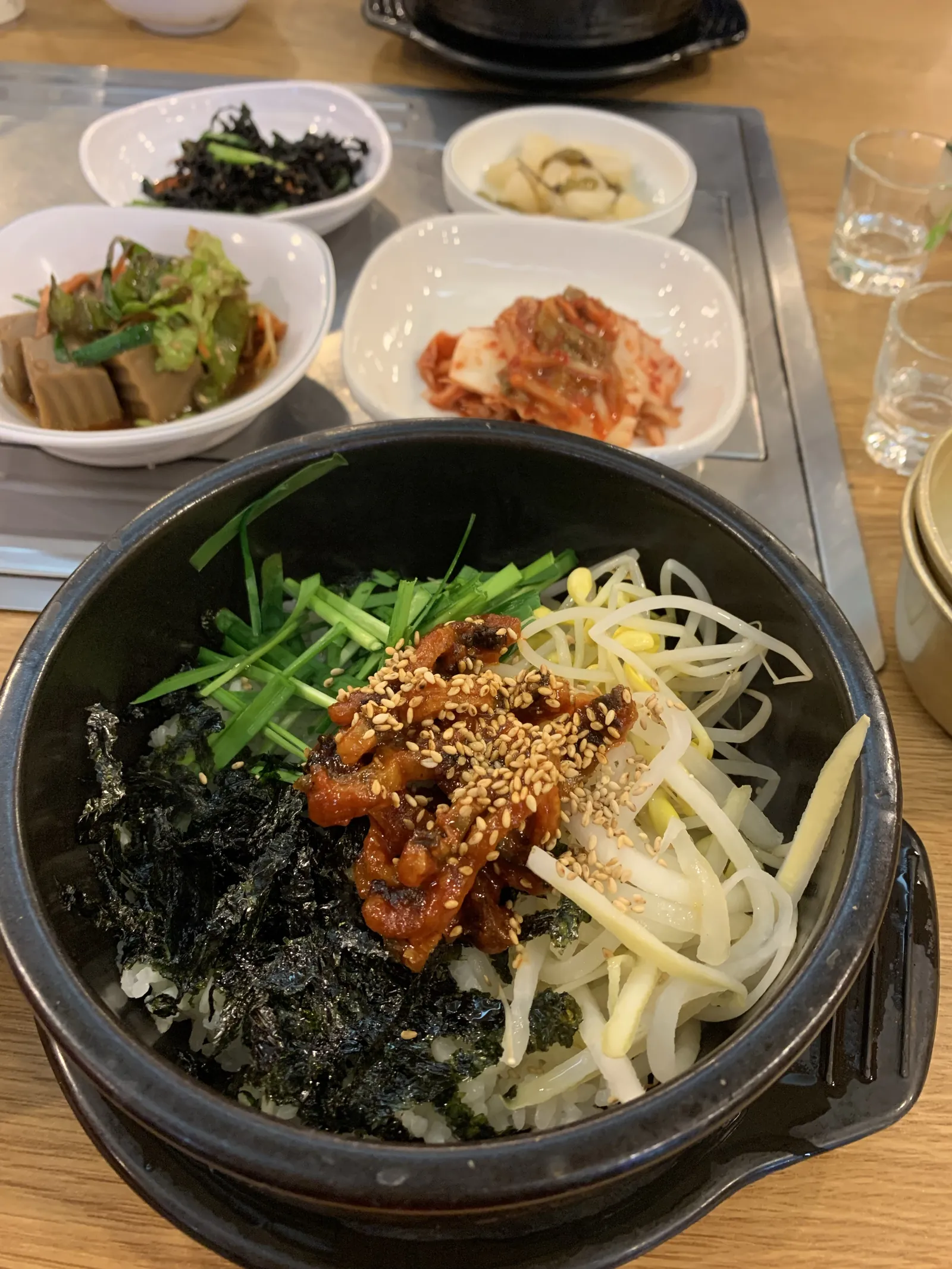
Bibimbap (비빔밥) is rice topped with an assortment of vegetables, an egg, often beef, and gochujang (a hot chilli paste). Before eating you mix it all together well — that’s exactly what the word “bibim” means. It looks simple, but that mixture creates something far greater than the sum of its parts: every bite is a little different, depending on what the spoon has picked up.
The best variation is dolsot bibimbap, served in a heated stone pot: the rice at the bottom fries and, as you eat the top, a golden crust forms. In Seoul the average bibimbap at a restaurant runs about 10,000–15,000 won (roughly €7–11). The city of Jeonju is considered the true capital of bibimbap.
Samgyeopsal — BBQ you grill yourself
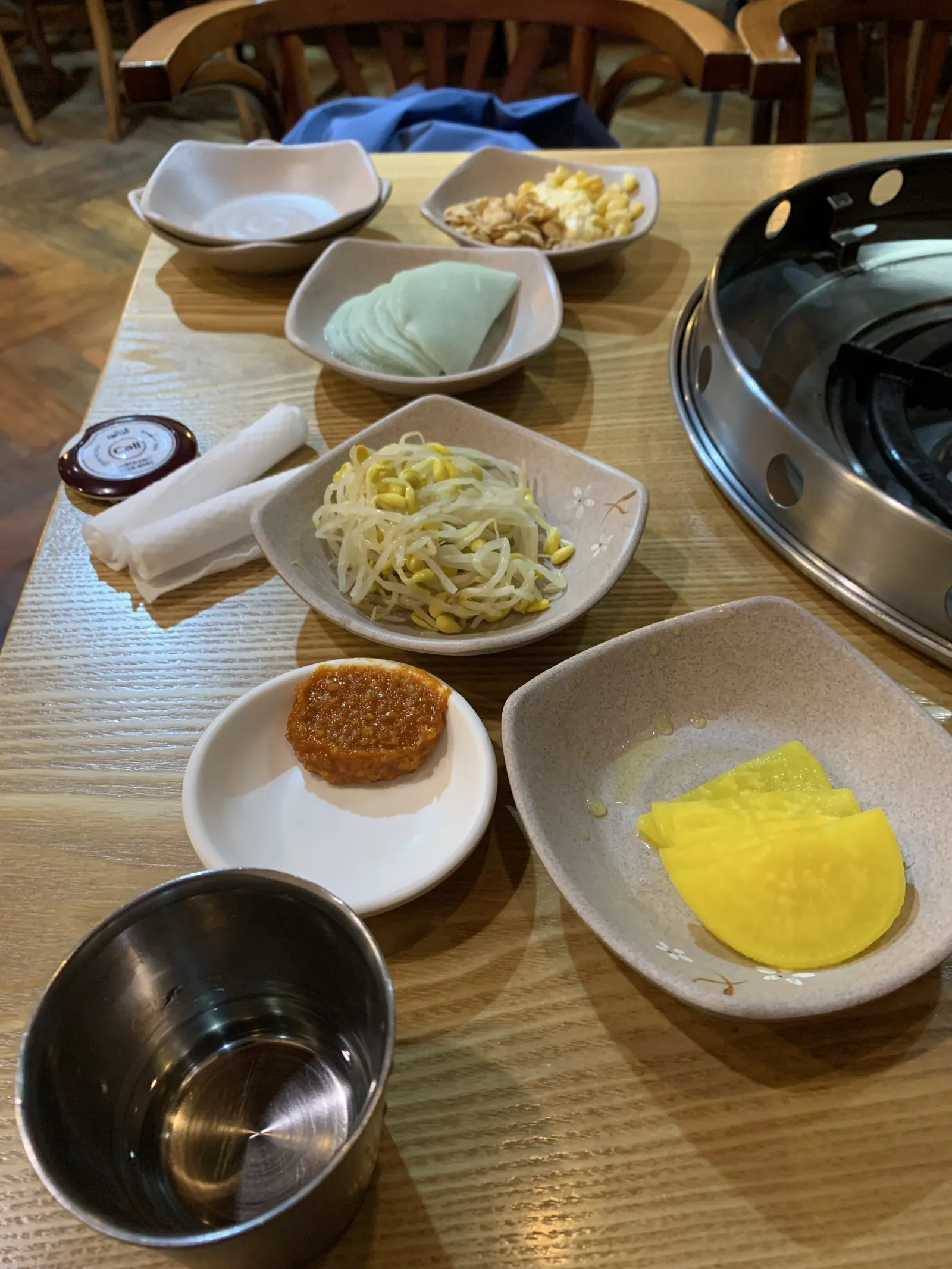
Samgyeopsal (삼겹살) is the foundation of Korean BBQ: strips of pork belly grilled on a grate built right into the table. The grilling process is a wonderful social ritual — everyone sits together, you take turns grilling, you chat, you wait. When the meat is ready, you wrap it in a lettuce leaf with kimchi, garlic and ssamjang paste — and eat it in one bite.
An average portion (about 150–200 g) costs around 18,000–21,000 won in Seoul (€13–15), and lately the larger portions already cross the 20,000-won mark. With rice, soup and all the banchan side dishes, one person often spends 25,000–40,000 won (€18–28). Prices vary depending on the district and the level of the restaurant, and there are plenty of cheaper places in the student districts.
Tteokbokki — the spicy king of street food
Tteokbokki (떡볶이) is rice-cake sticks stewed in a red, spicy gochujang sauce. It’s eaten from a paper cup at street stalls, in markets and at night markets. It’s one of the most widespread Korean snacks — quite a few locals eat it several times a week, and for many the taste of childhood is associated with exactly this.
A portion on the street costs about 3,000–5,000 won (€2–4). If you’re sensitive to heat, know this: standard tteokbokki can be quite spicy. You can ask for it less spicy, but the results vary — sometimes the heat is already in the sauce and hard to reduce.
Kimbap — the travel sandwich
Kimbap (김밥) looks like Japanese sushi rolls, but it’s a separate dish with its own logic: rice, vegetables, egg, often meat or tinned tuna, wrapped in a seaweed sheet. There’s no raw fish — it’s not sushi. It’s a quick, cheap, filling snack that Koreans take on a picnic, eat on the train, or buy at the market on the way to work.
Kimbap stalls at markets (especially Gwangjang) sell a portion for about 3,000–5,000 won (€2–4). In the convenience-store chains (GS25, CU, 7-Eleven) you’ll find ready-made rolls for 1,500–2,500 won — ideal for lunch on the move. Gwangjang market is especially famous for mayak kimbap — miniature rolls that are hard to stop eating.
Mandu — Korean dumplings
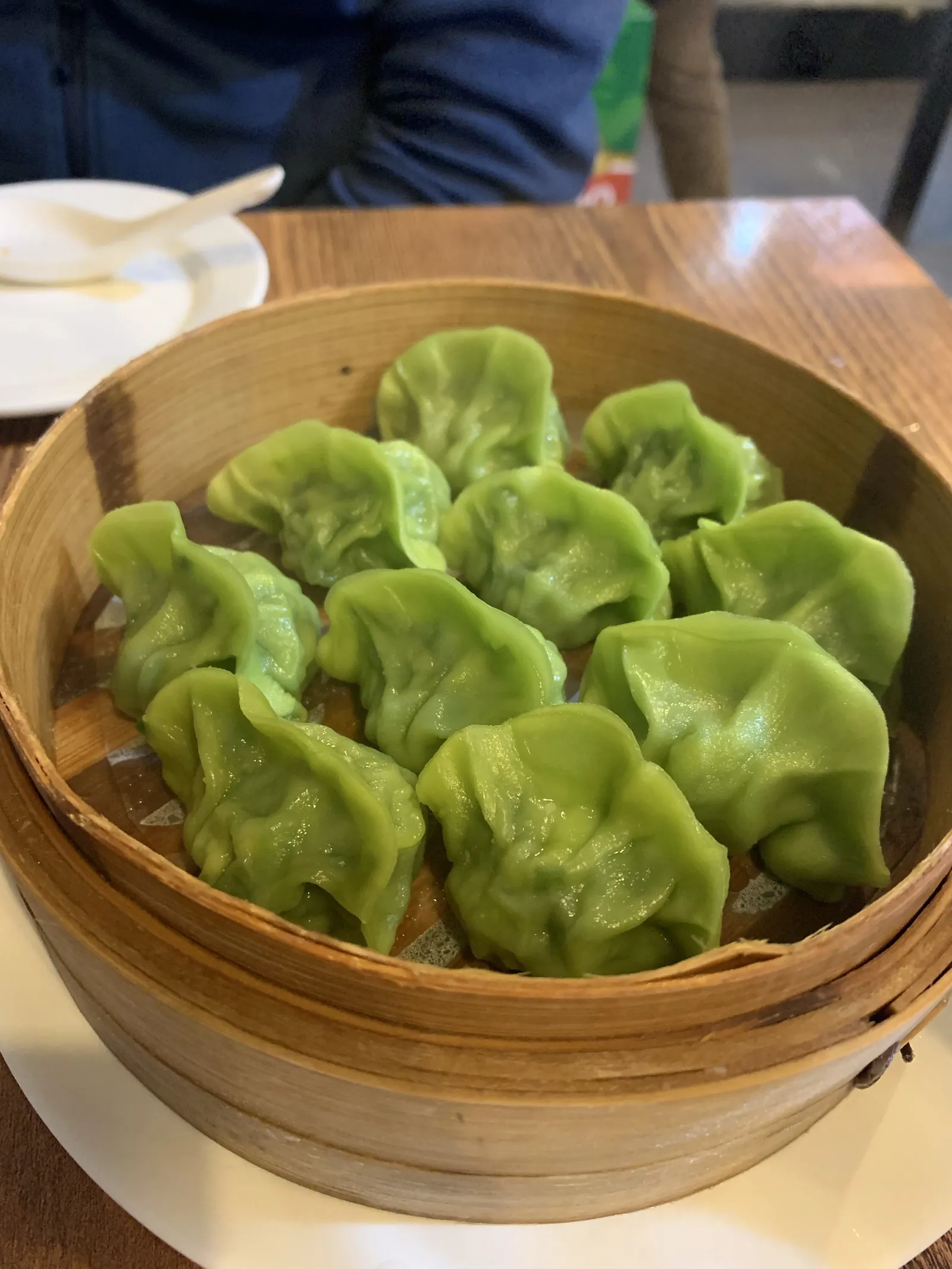
Mandu (만두) are Korean dumplings with various fillings: pork and tofu, kimchi, beef. They can be boiled, pan-fried, steamed or even added to a soup (mandu-guk). At Gwangjang market mandu is one of the iconic dishes — you buy it straight from the grandmother grilling them, get it on a paper tray and eat it standing up.
A portion (3–5 pieces) on the street costs about 3,000–5,000 won. Restaurants serve more, but the portion is bigger too, often with a stewed soup in which the mandu float. In winter a steaming mandu-guk is one of the more filling ways to warm up.
Bulgogi — marinated beef, tender and sweet
Bulgogi (불고기) is thinly sliced beef, marinated in soy sauce, sesame oil, sugar and onions, then grilled on a grate or in a pan. The taste is milder than samgyeopsal — less smoky, more sweet-umami. It’s one of the first Korean dishes that usually appeals to those unused to spicy food.
Bulgogi at a restaurant usually costs 15,000–25,000 won (€11–18). Traditionally it’s served with rice and banchan side dishes. If you’re travelling with children or with companions who are cautious about spicy food, bulgogi is a safe start for the whole group.
Bibim naengmyeon — refreshment on a hot day
Naengmyeon (냉면) are cold buckwheat noodles, served either in an icy broth (mul naengmyeon) or with a spicy gochujang sauce (bibim naengmyeon). In the warm season it’s one of Koreans’ favourite dishes: refreshing, slightly sour, with a boiled egg, cucumber and slices of pear on top. The noodles are long and chewy, so the waiter often offers to cut them with scissors.
A portion at a restaurant usually costs about 9,000–13,000 won (€7–10). Naengmyeon goes perfectly after a hearty BBQ — many Koreans end their meat dinner exactly this way, to “wash off” the richness.
Fermented dishes
Fermentation in Korea isn’t a trendy health topic, it’s simply a foundation of cooking, thousands of years old. Two dishes are absolute classics you really won’t avoid.
Kimchi — not a side, but a foundation
Kimchi (김치) appears on every table in every restaurant — free, without asking, and as many times as you ask for a refill. Classic kimchi is made from fermented napa cabbage with garlic, ginger, chilli-pepper paste and fish sauce. The taste is slightly sour, spicy, sometimes strongly fermented — the longer it’s aged, the more intense it gets.
But kimchi isn’t a single dish — there are dozens of variants: from radishes (kkakdugi), from cucumbers (oi-sobagi), from spring onions. If you’re a vegetarian or vegan, know this: traditional kimchi is often made with fish sauce or shrimp. More on that in the vegetarian section.
Doenjang jjigae — the soup that feeds the soul
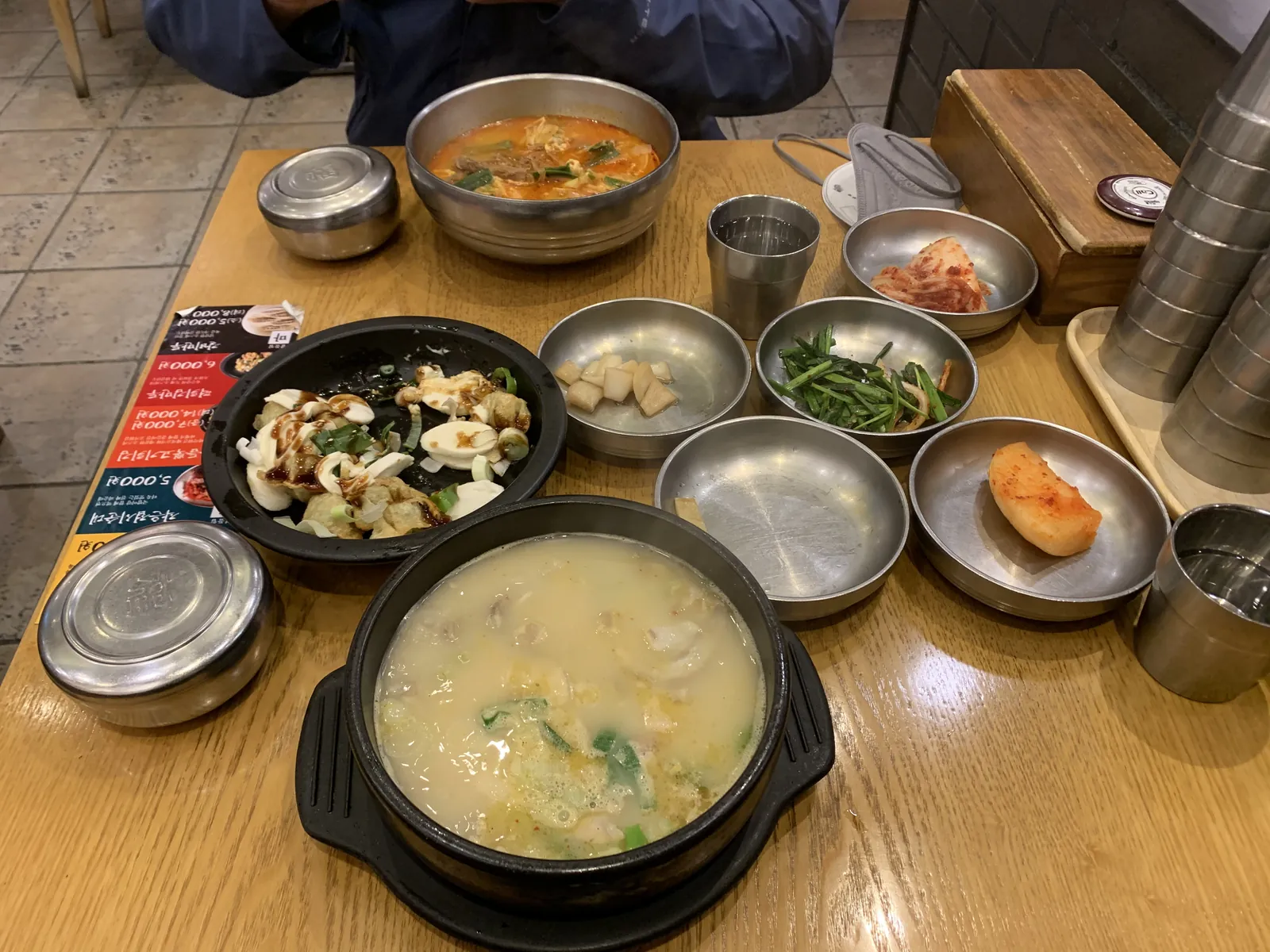
Doenjang jjigae (된장찌개) is a fermented soybean-paste soup with tofu, vegetables and often meat or mushrooms. Doenjang is the Korean answer to Japanese miso: darker, stronger in aroma, deeper in flavour. The soup is served boiling in a small clay pot right on the table — and it keeps bubbling for a long while as you eat.
It’s one of those dishes you eat in the morning, at lunch and for dinner. Prices at a restaurant are usually from 8,000 to 12,000 won (€6–9), most often with rice and banchan. If you want a spicier version, look for kimchi jjigae — the same kind of soup, only with fermented kimchi instead of soybean paste.
BBQ culture and banchan
The Korean BBQ experience is a ritual worth understanding before you go to a restaurant — so you don’t feel you spent half the evening staring at the grill built into the table, not knowing what to do.
Grilling at the table
In BBQ restaurants every table has a built-in grill and a ventilation pipe above. The meat is brought raw — from there you grill it yourself. Often a member of staff will come and do the first round of grilling themselves. Use scissors (they lie on every table) to cut the meat on the grate — that’s standard practice.
From the meat, build your own bite: take a lettuce leaf, add a piece of meat, kimchi, a grilled garlic clove, a dab of ssamjang paste and wrap it up. In Korean this is called ssam (쌈) — “wrapped”.
Banchan: the free side dishes
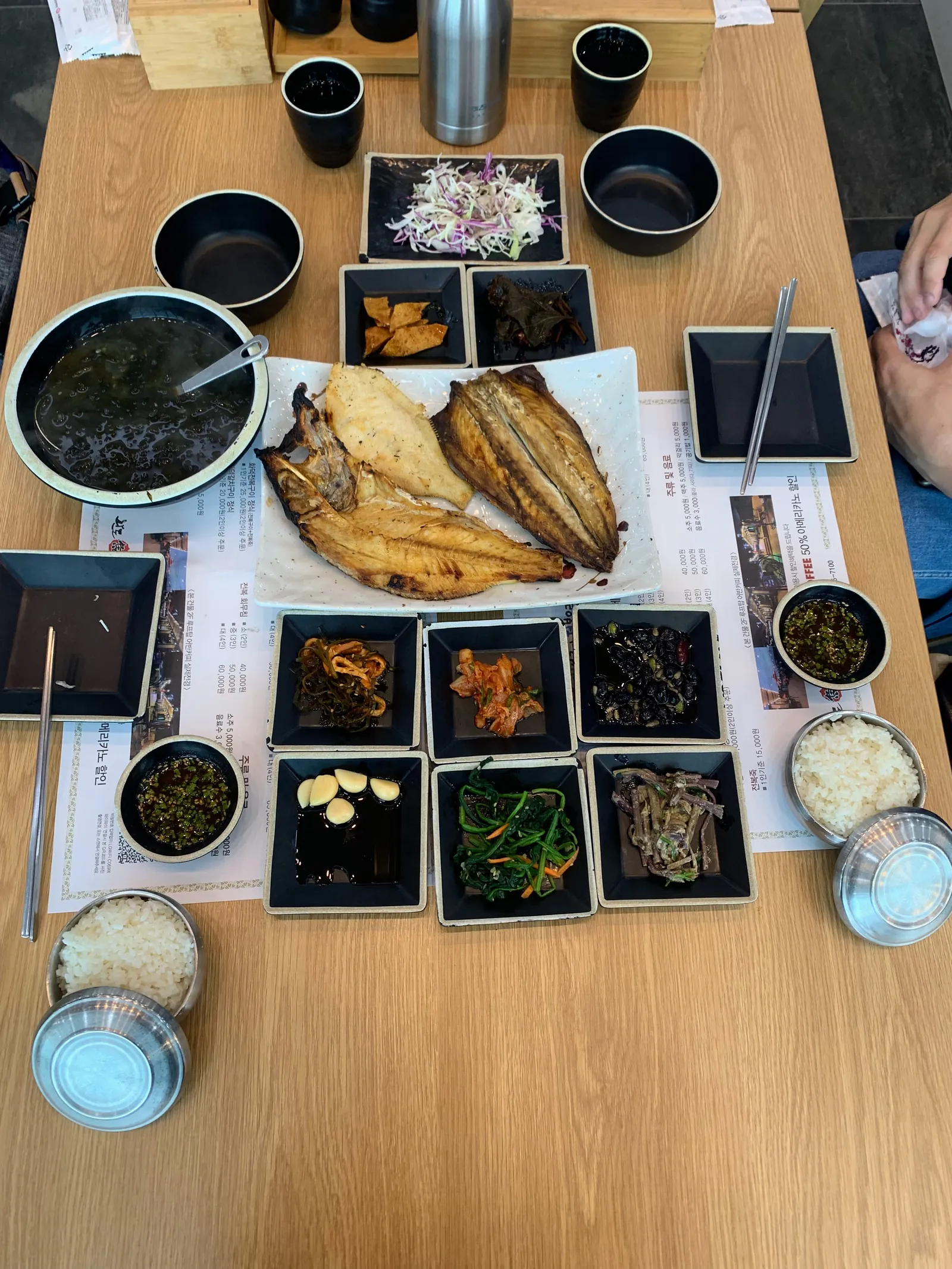
Every time you sit down at a restaurant, banchan (반찬) will appear in front of you — several little dishes of sides: kimchi, spinach in sesame oil, pickled radish, bean sprouts, an egg dish. These aren’t appetisers before the meal — they’re an inseparable part of eating, and they change depending on the restaurant.
The most important rule: banchan is free and with no refill limit. If the kimchi or spinach runs out — just ask for more. Say “이거 더 주세요” (i-geo deo juseyo) — “more of this, please” — or simply point at the dish and say “deo juseyo”. No one will be annoyed, and no one will count.
In Korea it’s not the custom to tip — it can even confuse the waiter. You pay what’s on the bill, and that’s it.
For vegetarians: temple cuisine and reality
Traditional Korean cuisine is very meat-based, and fish sauce is used even in dishes that look vegetarian (kimchi, many soups, some banchan).
Temple cuisine — the purest alternative
Korean temple cuisine (사찰음식, sachal eumsik) is a Buddhist tradition: the food is made without meat, fish, onions, garlic or ginger — the so-called “five pungent vegetables”. Instead there’s seasonal food, fermented mushrooms, herbs, tofu. The flavour is both subtle and deep.
In Seoul you’ll find temple-cuisine restaurants in the Insadong and Jongno districts. Balwoo Gongyang, run by the Jogye Buddhist order, offers sets from about 30,000 to 150,000 won — depending on the number of dishes. The Sanchon restaurant is a classic in the same area. It’s worth booking a table before dinner, especially at weekends.
Practical difficulties
Outside temple restaurants it’s hard to know what exactly goes into the dishes. “Vegetarian” in Korean (채식주의자, chaeshik jujuija) often means without pieces of meat — but not without fish sauce or a broth base. If you’re a strict vegetarian or vegan, it’s recommended to look for specially marked vegan-friendly restaurants in the big cities or to ask the staff directly.
Seoul and Busan have more and more vegan cafés and bistros — you’ll find lists of them in specialised apps and maps. In smaller cities the choice is considerably narrower, so it’s worth preparing in advance and noting down a few places before you set off.
Street food: markets and night markets
The best Korean food isn’t always in a three-star restaurant. Often it’s found by a metal stall, where one person grills one dish their whole life and does it better than anyone else.
Gwangjang market — the first encounter
Gwangjang (광장시장) in the Jongno district is one of the most iconic street-food spots in Seoul. This is where bindaetteok (mung-bean pancakes) became famous, where you taste yukhoe (a raw-beef salad with pear and sesame oil), where you buy kimbap from a grandmother who has kept the same spot for decades. The market operates during the day, but in the evening it becomes especially lively.
Namdaemun market is bigger and more mixed — here you’ll find hotteok (sweet pancakes with sugar and nuts), kalguksu (a knife-cut noodle soup) and lots of smaller snacks. At both places most stalls work with cash — take some notes, because not everywhere accepts cards.
Myeongdong and night markets
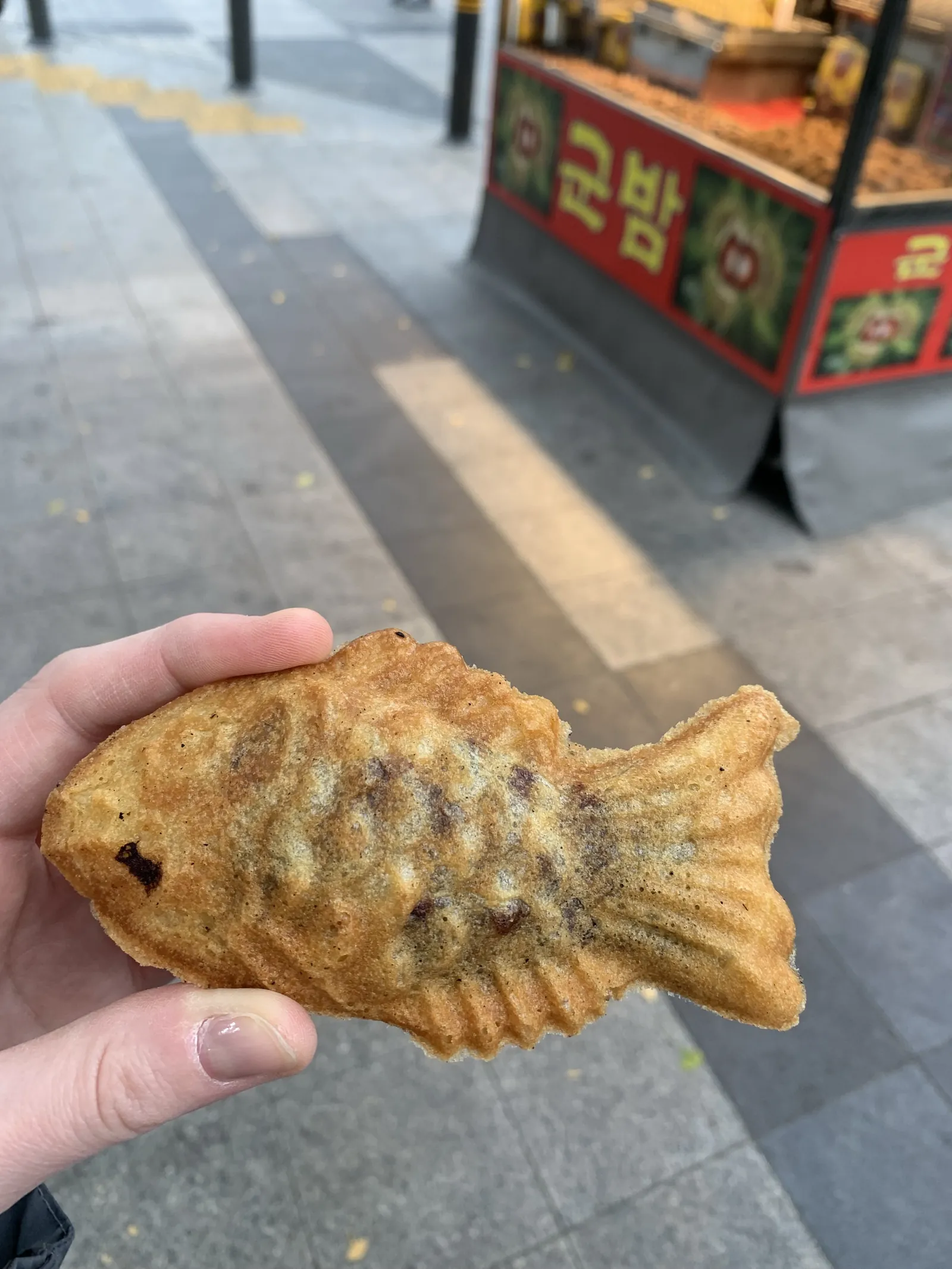
Myeongdong isn’t only a shopping district — in the evenings dozens of street-food stalls open here with tteokbokki, hotteok, twigim (fried snacks) and everything that’s grilled, boiled or heated in public. It’s a more touristy zone, the prices a little higher than elsewhere, but the sight and the energy make it worth a visit.
If your trip heads east — in the city of Sokcho you’ll find excellent seafood street food: fresh oysters, grilled squid, seafood pajeon (pancakes). Sokcho market is one of the least touristy but best markets of its kind in Korea.
How to order and pay in a restaurant
Korean restaurants can look chaotic: the menu is often only in Korean, the waiters don’t always speak English, and in some places there’s no menu at all — just two or three dishes written on the wall. But the system works perfectly once you understand the logic.
Ordering
In many modern restaurants there’s a tablet or a QR code — you order yourself, and the menu is often translated into English. In older restaurants you call out “저기요!” (jeo-gi-yo) — “excuse me!” — and wait.
Paying
Korea is practically a contactless country — cards are accepted almost everywhere, from big restaurants to little noodle bars. Street-food stalls and markets still more often work with cash. Tips are not customary — you pay the amount on the bill.
Where to find good places: markets, locals and apps
Tourist lists and “top 10” rankings often point to the same uniform places with English menus and doubled prices. Here’s how to find the real Korea.
- Naver Maps — the Korean equivalent of Google Maps, used by the locals. Restaurant ratings here are much more accurate. Search by district or by dish.
- Traditional markets — Gwangjang, Namdaemun, Tongin in Seoul; the Jagalchi fish market in Busan; Sokcho market on the coast. There you eat what the locals eat.
- University districts — Hongdae, Sinchon in Seoul. Lots of students means lots of cheap, good restaurants with quick meals.
- Ask your hotel or guide — “Where do you eat yourself?” will give a better answer than any list online.
- A queue at the door — if there’s a queue in front of a restaurant at midday, that’s a good sign. Koreans don’t wait outside bad places.
South Korea is much more than Seoul — all these rules apply in the regions too. More on how to plan a trip around the whole country: the South Korea traveller’s guide.
FAQ
Is Korean food always very spicy? No, but spicy food is very widespread. Tteokbokki, kimchi jjigae and most jjigae soups are spicy. Bibimbap, bulgogi, kimbap, doenjang jjigae are of medium or minimal spiciness. At a restaurant you can ask for it less spicy (맵지 않게 해주세요), though it isn’t always possible to change the flavour of a dish completely. Sensitive stomach — go for the bulgogi or doenjang jjigae direction.
Do the banchan (side dishes) cost extra? No. Banchan is free, and you can ask for a refill as many times as you like, at no extra charge. It’s a standard Korean tradition — the sides come with the main dish, and refilling them is expected and acceptable. Simply say “banchan deo juseyo” or point at the dish you want.
What’s the daily food budget in Korea? A thrifty traveller choosing street food and simple little restaurants can eat very well for 15,000–25,000 won (about €11–18) a day. A medium budget with sit-down restaurants and BBQ in the evening — 35,000–60,000 won (€25–43). A BBQ dinner in a group can cost less per person, because the portions are oriented towards sharing.
Can you eat in Korea without being able to read Korean? Yes, especially in the big cities. Many modern restaurants in Seoul, Busan and Jeonju have English menus or photos of the dishes, so you can simply point. The Naver Maps app shows restaurants with menu photos, and the Google Translate camera can translate Korean text in real time just by photographing the menu. A few Korean phrases (like the ones above) will make communication much easier.
Is it hard for vegetarians in Korea? Traditional Korean cuisine is meat-based and uses fish sauce in many dishes, including kimchi. However, temple-cuisine restaurants (in Seoul’s Insadong district and in other cities) offer fully vegetarian and vegan food. In the bigger cities there are more and more specially marked vegan restaurants. In smaller towns the choice is considerably narrower, so it’s worth preparing in advance.
Find flights here. If something goes wrong with your flight, you can claim compensation via AirHelp or Compensair.
Staying connected? Skip expensive roaming and grab an eSIM plan — set it up before you fly and you’ll have data the moment you land.
I always recommend booking airport transfers in advance. You can do that here.
Find accommodation here.

Travel Without Chaos: South Korea — 14-Day Itinerary Without a Car (+ National Parks)
14-day South Korea itinerary — complete PDF guide, no car needed. Seoul, Seoraksan, Jeonju, Jeju and Hallasan. Daily plans, budgets, hotels and transport.