Jeju Island has plenty to see: flowers growing inside volcanic craters, black basalt coastlines, mandarin orchards. But one sight stays with you more than any other — elderly women in rubber suits emerging from the sea with nets full of sea urchins and abalone. They are called haenyeo. Below, I explain who they are and where to see them.
Some links in this article are affiliate links. If you book through them I earn a small commission, at no extra cost to you.
Contents
- What is a haenyeo?
- A centuries-old tradition
- UNESCO Intangible Cultural Heritage status
- Why the haenyeo may disappear
- Where to see the haenyeo on Jeju: the three best spots
- 1. The Seongsan coast — live demonstrations
- 2. The Jeju Haenyeo Museum — the best cultural context
- 3. Yongduam (Dragon Head) Rock — free, with seafood restaurants
- How to behave respectfully
- When is the best time to come?
- Haenyeo food: what to taste
- Frequently asked questions
- Can you watch the haenyeo for free?
- How deep do the haenyeo dive?
- When do the haenyeo demonstrations take place in Seongsan?
- Will the haenyeo tradition survive?
- Can you photograph the haenyeo?
- What is a bulteok and why is it important?
Look for flights to the island here.
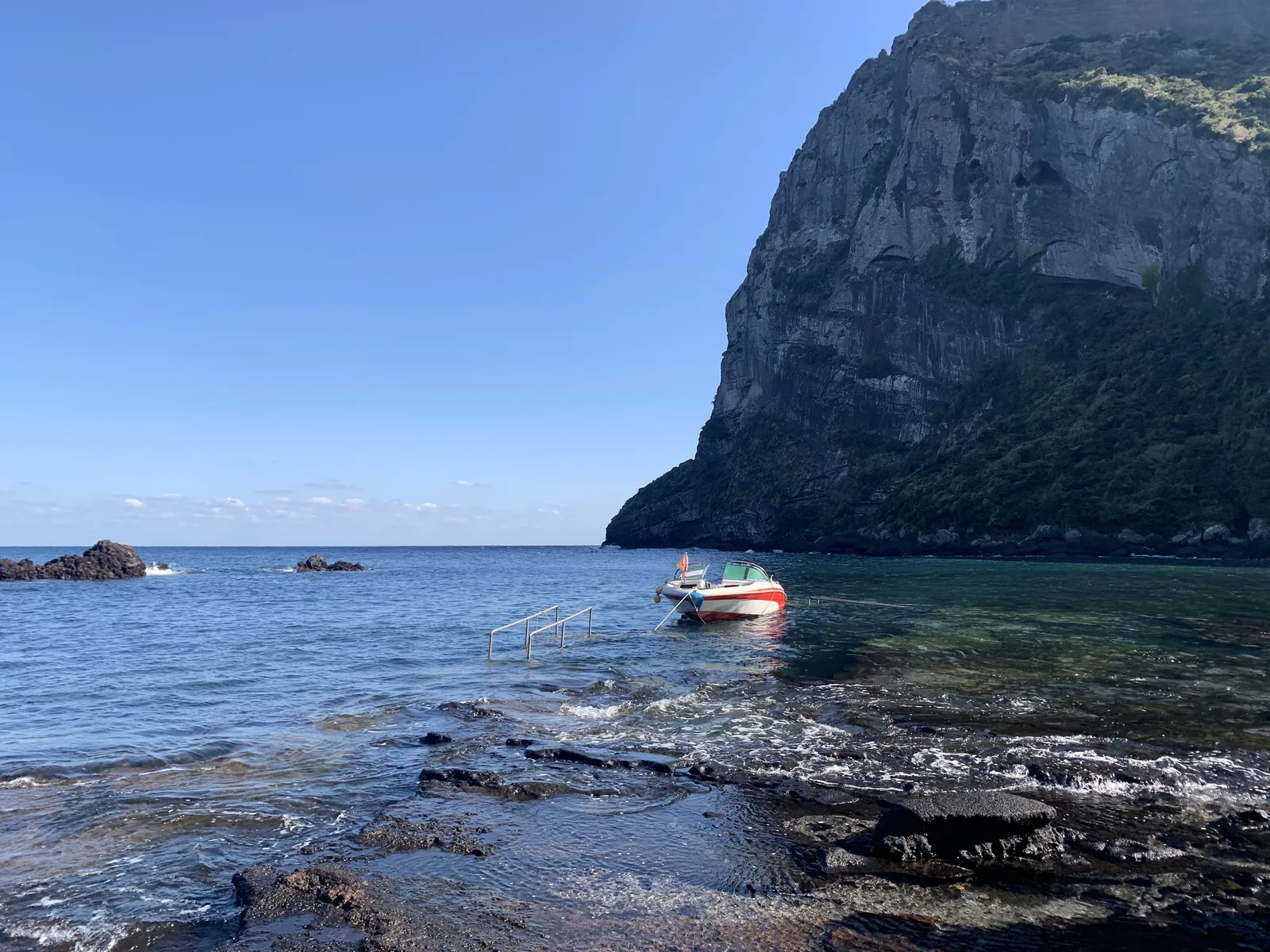
What is a haenyeo?
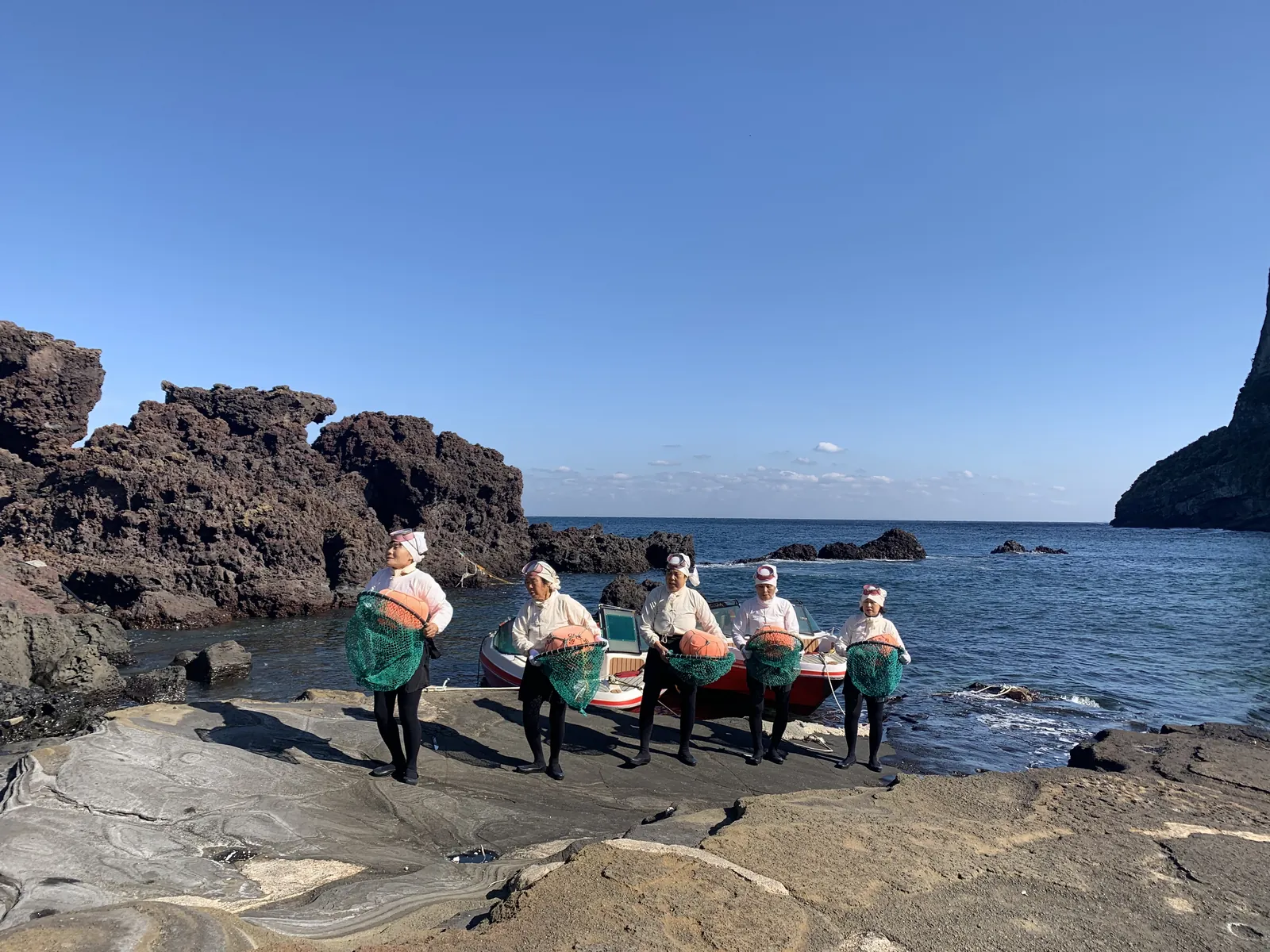
Haenyeo (해녀) translated from Korean means “sea woman.” These are Jeju Island’s traditional divers, who plunge into the ocean without any oxygen tanks and gather seafood from the seabed — abalone, sea snails, octopus, sea urchins and seaweed. It is work these women do their whole lives.
The deepest dives reach around 20 metres, though most dives are far shallower. The depth depends on what they are looking for that day. They stay underwater for anywhere from one to three minutes, and spend a working day diving for several hours at a time. They use no professional diving equipment: a rubber suit, goggles, a weight at the waist, and simple hand tools. Their main advantage is their lungs and their experience.
As they surface, they release a distinctive whistling sound — sumbisori (숨비소리). This is a sudden exhale-and-inhale technique that helps them quickly restore their oxygen and prepare for the next dive. Many people gather specifically to watch these dives and this unique diving technique.
They develop their breath-holding and diving skills from a young age, and the ability to stay underwater for long stretches comes with years of practice. Older divers often go deeper and longer than younger ones, which is why experience is regarded as a defining asset in this occupation. The haenyeo group themselves by experience: the most experienced dive the farthest and the deepest, while beginners stay closer to shore in the shallows.
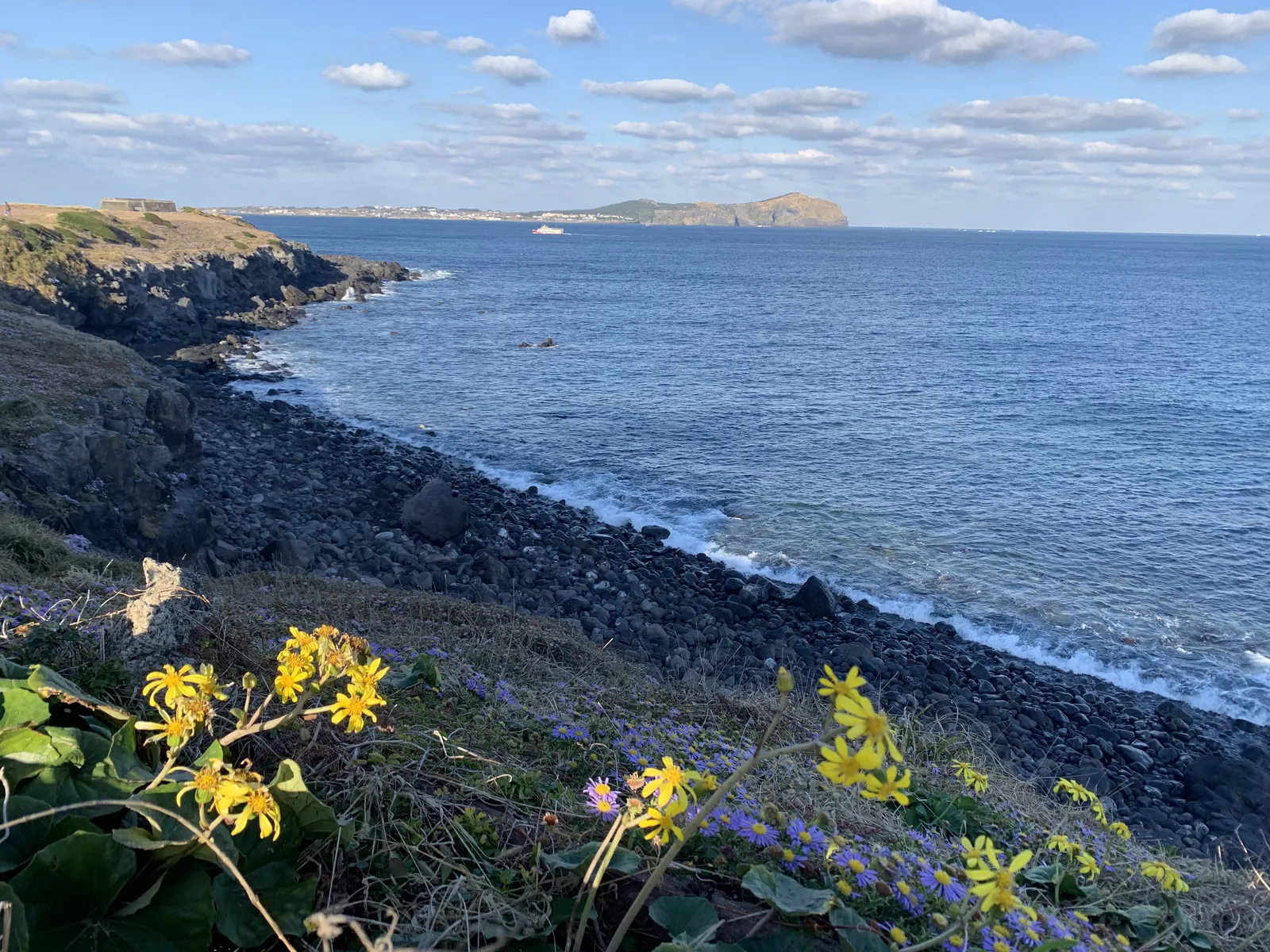
A centuries-old tradition
Jeju’s tradition of women diving reaches deep into the past. In the beginning both men and women dived, but over time it became an almost exclusively female activity. The reasons were practical: it was believed that women’s bodies coped better with long spells in cold water, and it was more advantageous for families to have the women working at sea.
Because of this profession, Jeju society developed in an unusual way — a strong female role in the family economy has survived here. Women earned the main income, while men often stayed home with the children or did other work. The haenyeo held high status in the community: they fed their families, contributed to taxes, and made financial decisions. Traces of this independence can still be felt in Jeju culture today.
For a long time, diving was not a choice for Jeju’s women but a way to survive on an island where the land is stony and there is little to farm. The sea became the main source of food and income, and the ability to “read” it while diving became the most valuable skill a mother could pass on to her daughter. Often an entire female line of a family — grandmother, mother and daughter — belonged to the same diving community and shared the same stretches of coast.
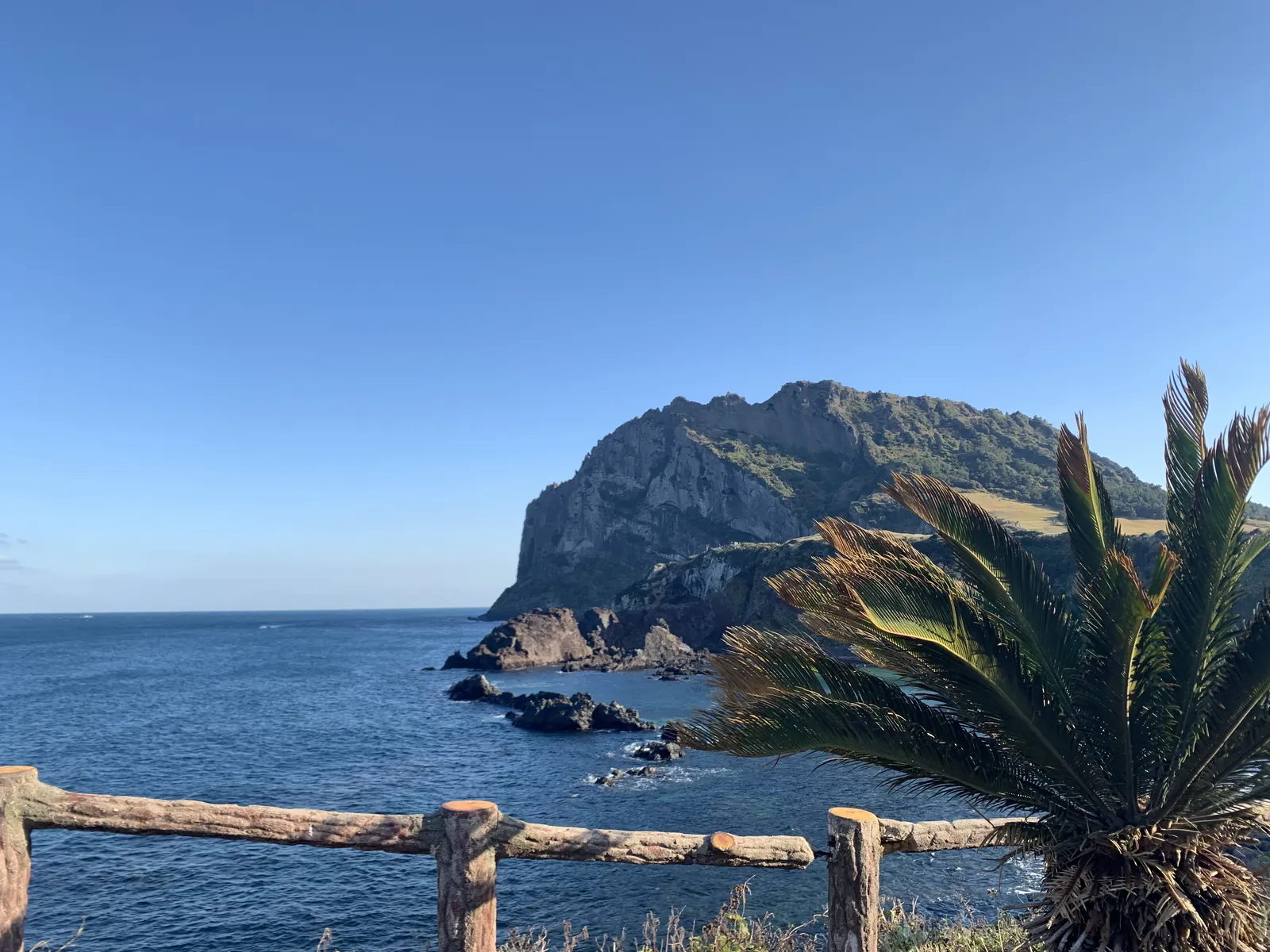
UNESCO Intangible Cultural Heritage status
Haenyeo culture is not only a diving technique; it is knowledge passed down from generation to generation: how to understand the waves, which areas are taken and when, how to share resources so the sea is not depleted. In 2016, UNESCO added this culture to its Intangible Cultural Heritage list.
An important part of this culture is the bulteok (불턱). This is a round stone windbreak by the shore where the haenyeo gather before and after their dives. Here they change clothes, warm themselves by the fire, discuss where and how to dive, and settle community matters. It was a place for making decisions, where each woman had her own voice. No orders come from above — everything is worked out through discussion around the fire, and the experienced divers pass their knowledge to the younger ones.
The FAO (the United Nations Food and Agriculture Organization) recognised the haenyeo fishing system as a Globally Important Agricultural Heritage System. This is a rare distinction, usually reserved for traditional agriculture, but here it acknowledged that these women use sustainable, ecologically balanced fishing practices — they themselves limit how much they take and when, so that some is left for the future.
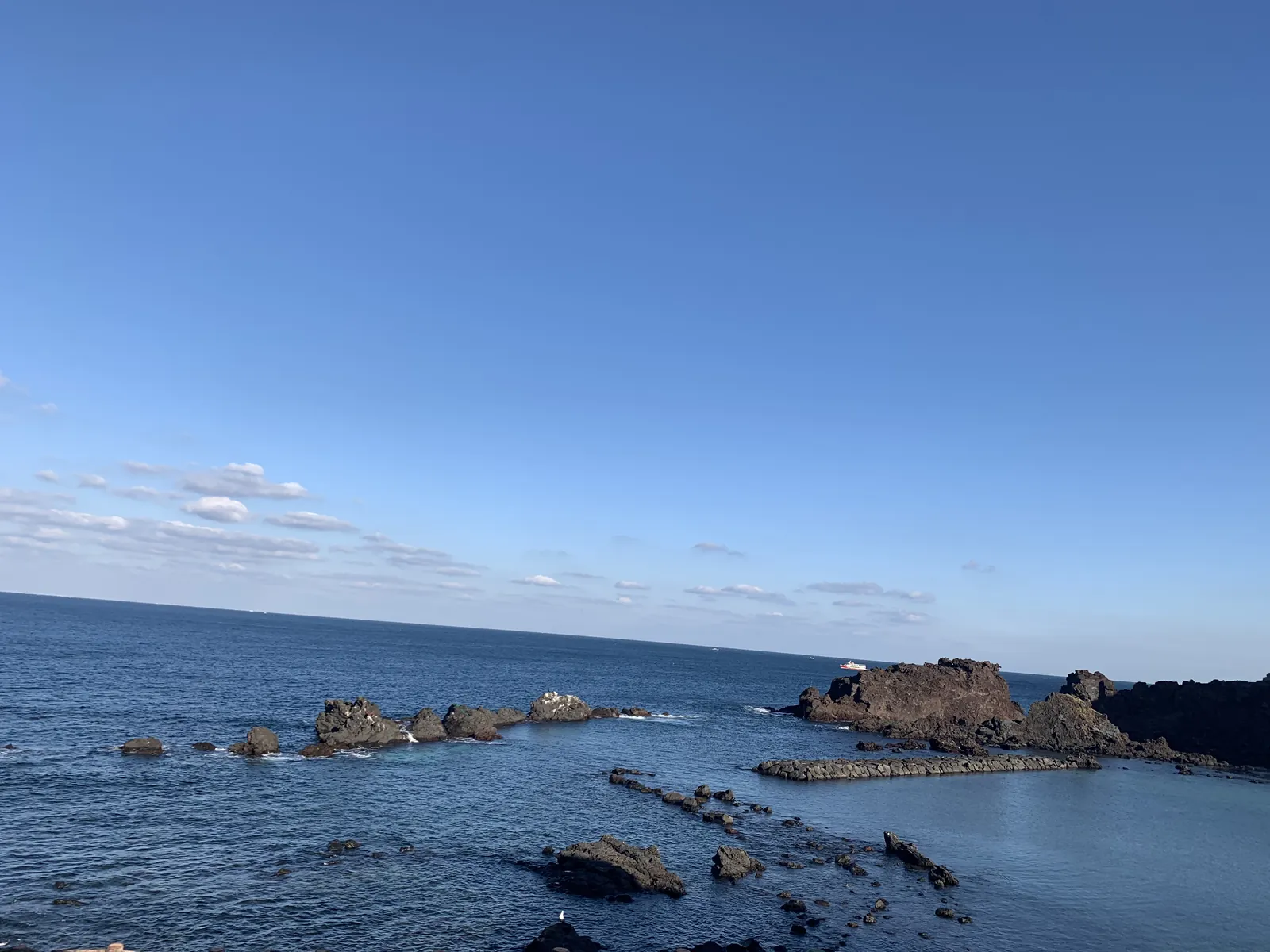
Why the haenyeo may disappear
Today there are roughly 2,700–2,800 active haenyeo left on Jeju Island. Nearly 90 percent of them are 60 or older. Here, women in their sixties are considered “young.” Most of the divers are women in their seventies and eighties who still climb into the water every day.
There are very few young women willing to continue this tradition. The work is hard, the income is unstable, and the way of life seems too harsh to the modern generation. Compared with the tens of thousands of haenyeo who worked several decades ago, the current number shows how quickly the tradition is fading. It may be that in a few decades it will survive only in museums and photographs.
If you are planning a trip to South Korea, Jeju Island is a place you simply must visit. The haenyeo are best seen now, while they are still diving.
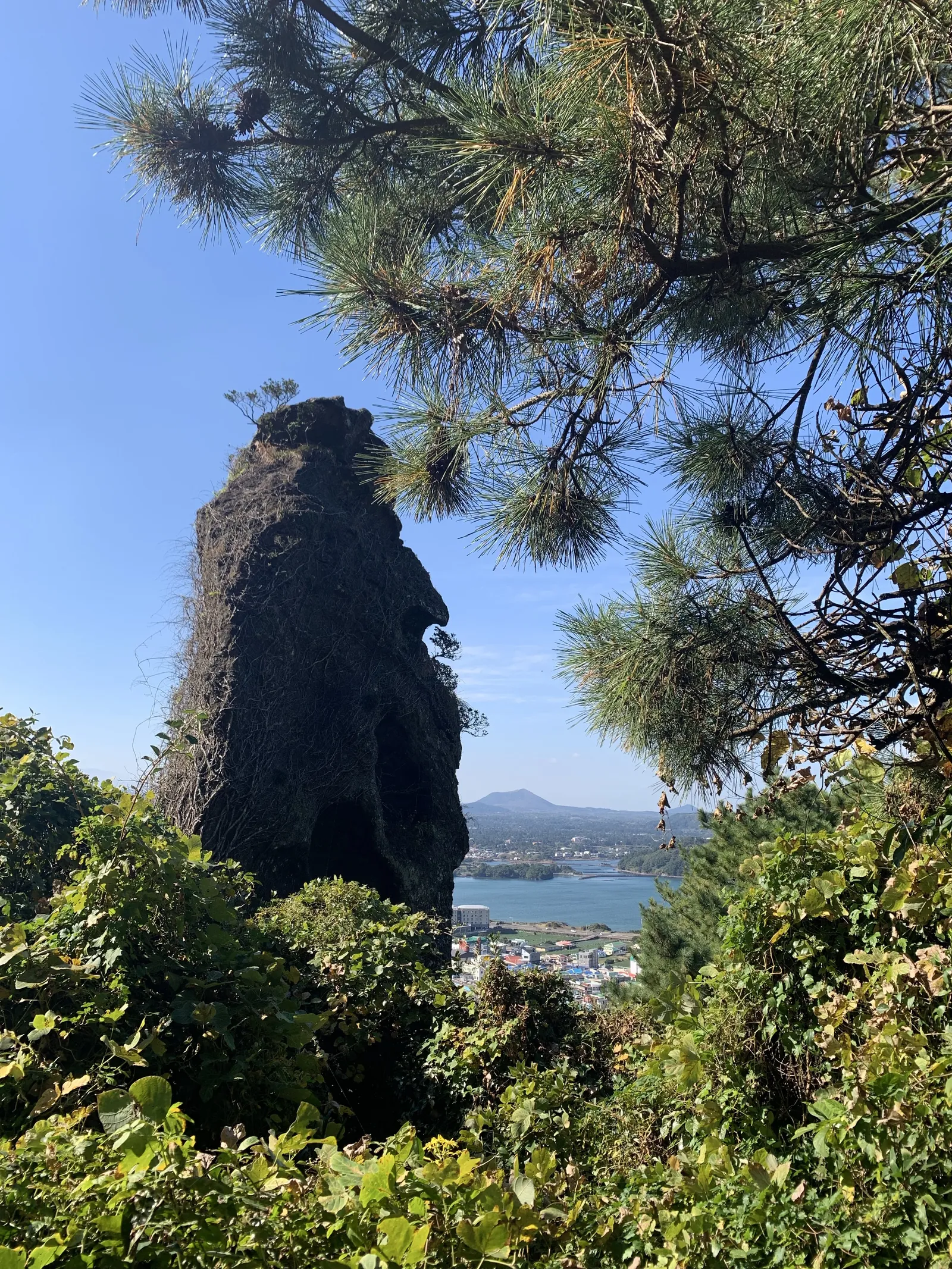
Where to see the haenyeo on Jeju: the three best spots
1. The Seongsan coast — live demonstrations
If you want to see the haenyeo at work, a good choice is the town of Seongsan, right beside Seongsan Ilchulbong (Sunrise Peak). By the rocky bay, the haenyeo put on short demonstrations: they dive, bring up their catch, sing work songs, and spectators can watch up close.
The demonstrations usually take place during the day, but the timing can change depending on the season and the weather. It is best to check the schedule once you arrive, because this is not a ticketed show but a living continuation of a culture, one that can be disrupted by rough seas or bad weather.
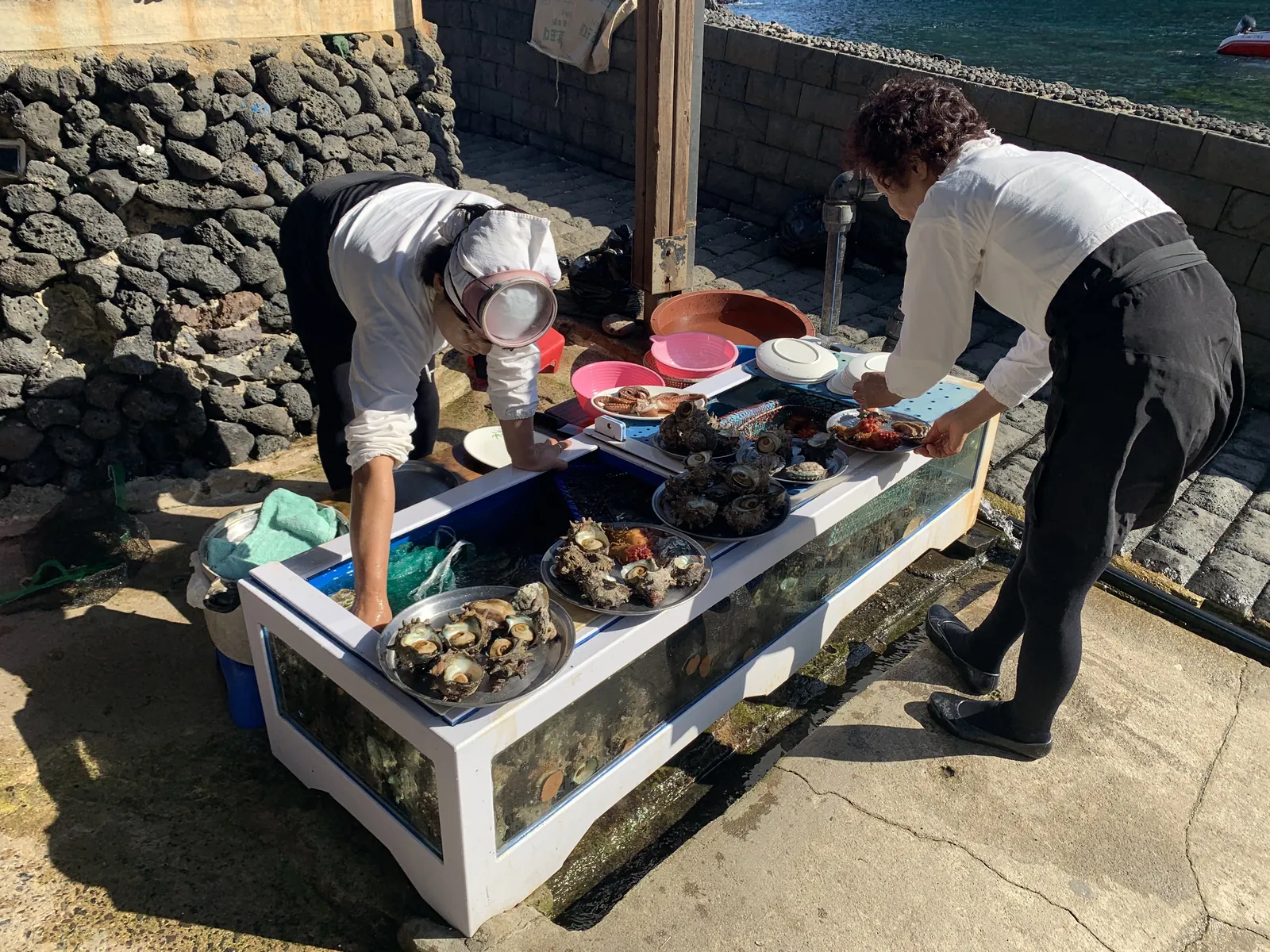
Nearby there is a sea women’s eatery where you can taste what they bring up from the sea — abalone, sea urchins, fresh hoe (thinly sliced raw fish or seafood). If you have never tried truly fresh seafood straight from the sea, this is a great place to give it a go.
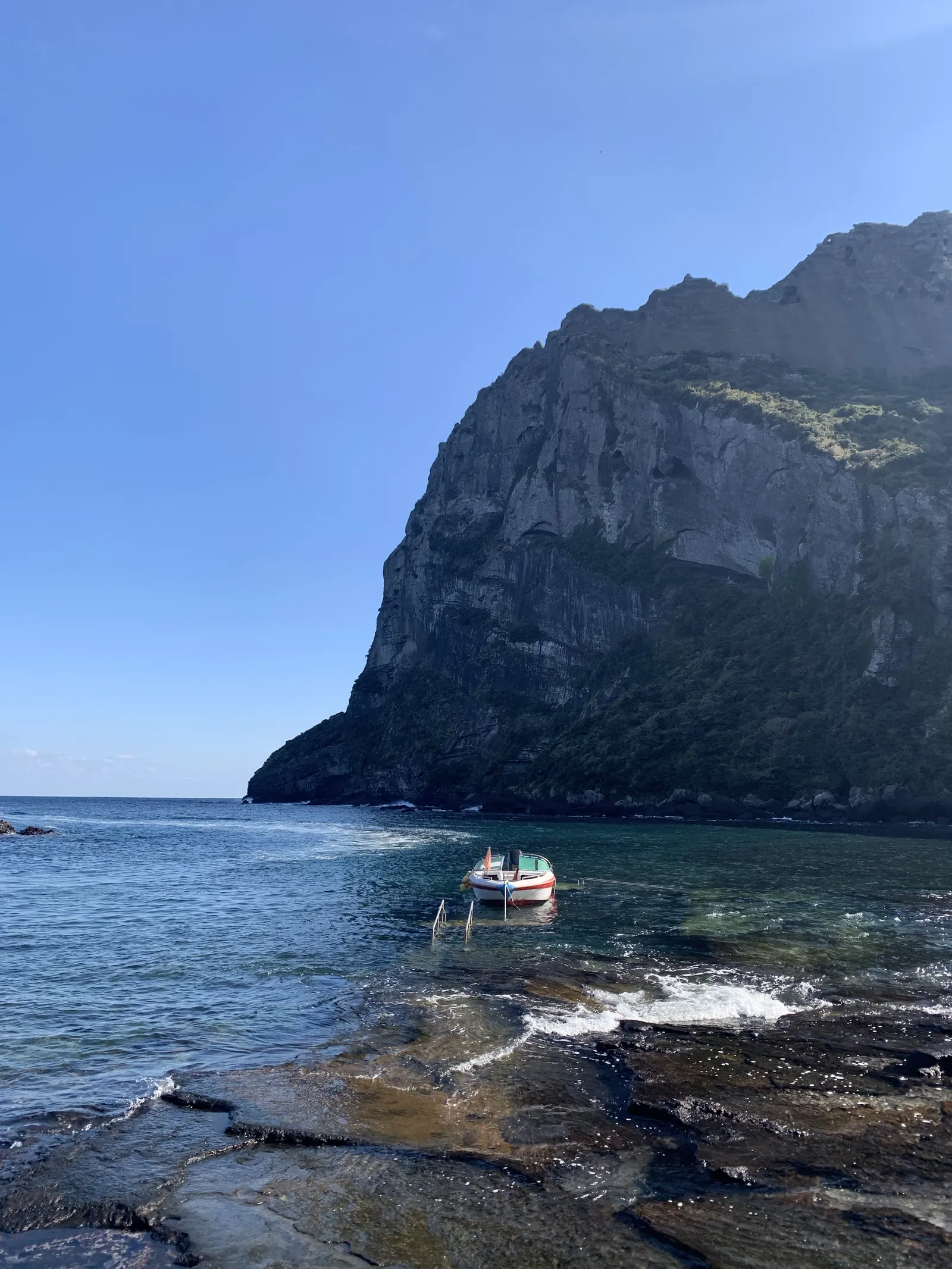
2. The Jeju Haenyeo Museum — the best cultural context
The museum is located in eastern Jeju, in the Gujwa-eup district. Here the story of the haenyeo is told through its exhibits: costumes, tools, boats, photographs. There is a reconstructed haenyeo house, an exhibition about their food culture and community life, and audio and video recordings in which the divers themselves speak.
It is a heartfelt museum, and you leave with a better understanding of what a haenyeo’s day looks like from early morning to evening, how much these women depend on the sea, and why the bulteok is not just a building but a social system.
- Opening hours: usually 9:00–18:00, with last entry around 17:30.
- Closed on certain days of the week and during parts of public holidays. Be sure to check before going.
- The ticket price is symbolic — about 1,100 won for an adult (around 1 euro), cheaper for young people.
- There is a free car park at the museum.
The setting around the museum is quiet and off the main tourist routes; the village of Hado is nearby, where on some mornings you can see women heading down to the sea.
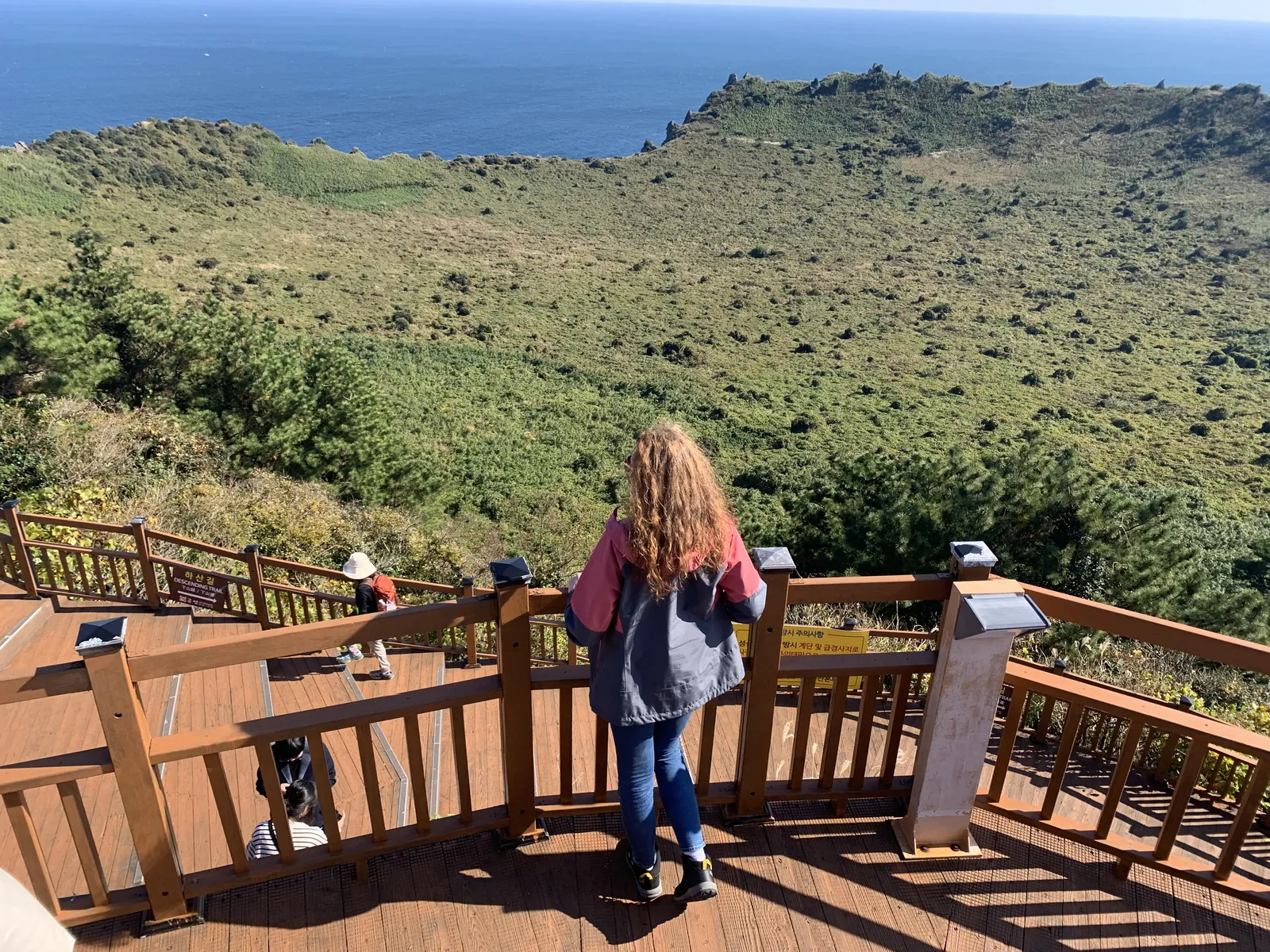
3. Yongduam (Dragon Head) Rock — free, with seafood restaurants
Yongduam is a basalt rock about ten metres high on the northern edge of Jeju City, carved by the waves and wind into the shape of a dragon’s head. Entry is free and the site is open around the clock.
It is not a dedicated haenyeo-watching spot, but the divers sometimes work in the surrounding waters, and seafood restaurants line up beside the rock, some of which sell exactly what has been caught in the sea. If you want to see a beautiful coastline, eat real Jeju hoe, and perhaps spot a diver all in one go, Yongduam is the place to do it.
The evening here is especially lovely: the sunset over the sea, a gentle breeze, and women returning home with full nets. If you are travelling around Jeju without a car, Yongduam is reachable by public transport from Jeju City centre.
How to behave respectfully
The haenyeo are not a tourist attraction; this is women’s work. Even during an official demonstration, they dive every day to make a living. A few simple principles to follow out of respect for this culture:
- Watch from a distance. Do not crowd right up to the shore or to the spot where they climb into the water.
- Photograph carefully — wait for the right moment and don’t get under a woman’s arm while she is working.
- Don’t block their way — the diving steps, platforms and bulteok spaces are workplaces.
- If a woman smiles and lets you take a photo — wonderful. If she turns away or clearly wants no attention — respect that.
When is the best time to come?
The haenyeo dive for most of the year, mainly during the warm season. In winter their activity drops off, because the water is too cold even for these women. During the warm months the chances of watching them are greatest, but that is also when there are the most tourists.
If you want a calmer atmosphere, choose the morning. The haenyeo usually start early, before the crowds of tourists. The Seongsan demonstrations mostly take place during the day, but the areas around the museum and Hado village are much quieter in the morning.
The weather on Jeju changes quickly, so dives can be cancelled. If you are planning a whole day’s programme around watching the haenyeo, have a backup plan.
In practice, the most convenient thing is to combine all three spots into a single route: start the morning at the Seongsan coast on the eastern end of the island, stop by the haenyeo museum around midday, and finish the evening at Yongduam Rock in Jeju City. That way, in one day you see the live demonstrations, the cultural context, and the coastline with its restaurants, with time in between to stop at mandarin orchards or basalt rock formations. If you are travelling by public transport, it is worth checking the distances between these points in advance — the eastern part of the island is fairly far from Jeju City.
Haenyeo food: what to taste
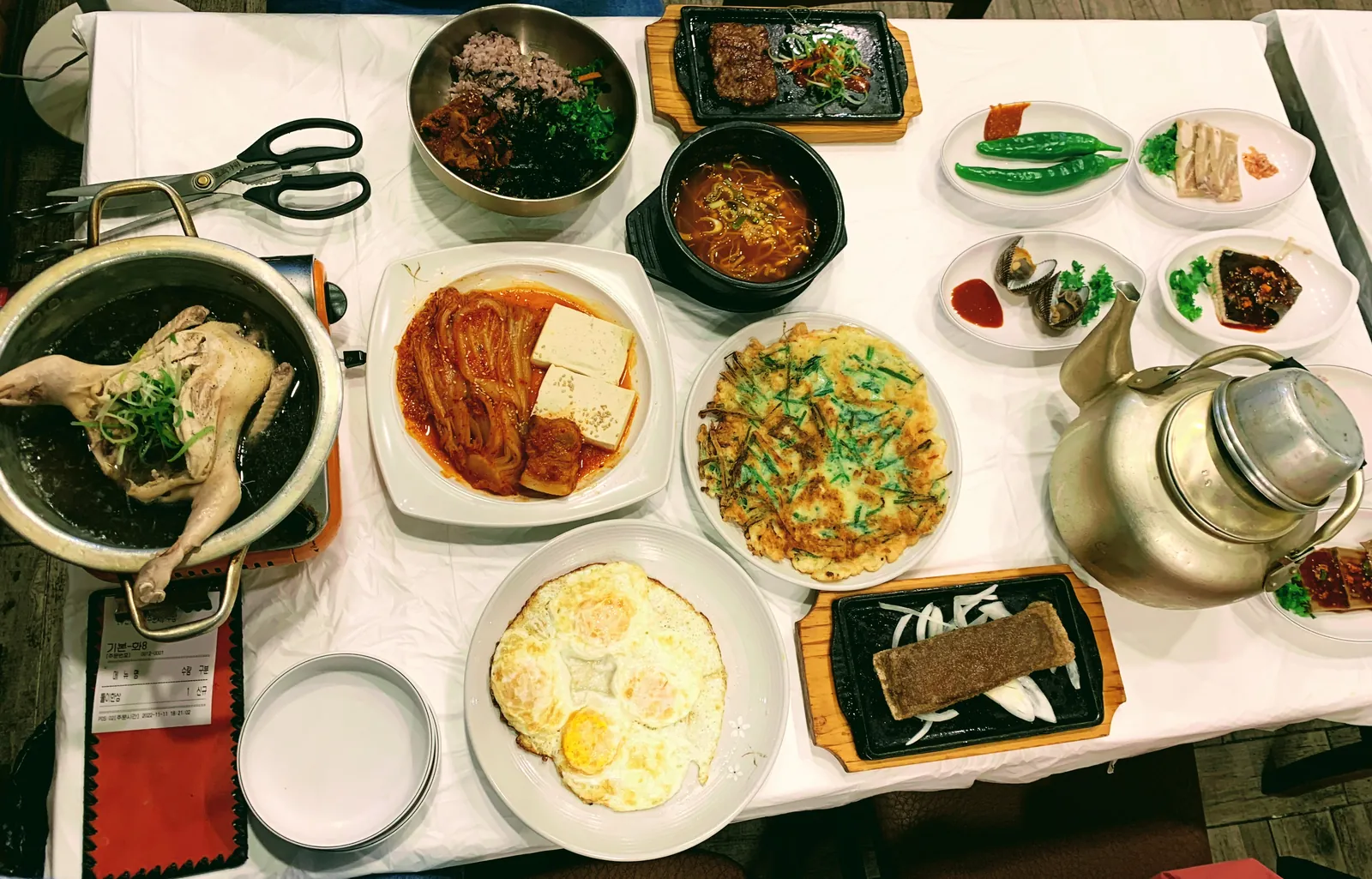
Most of what the haenyeo bring up from the sea goes straight onto the tables of Jeju’s restaurants. If you have not yet tried the local seafood, this is a good chance to fix that.
- Abalone (전복, jeonbok) — a Jeju delicacy. Served braised, as a rice porridge, or raw with a citrus sauce.
- Sea urchin (성게, seonggae) — mild, rich in flavour and yellow in colour. Excellent over rice or in soup.
- Hoe (회) — thinly sliced raw fish or seafood. Eaten with gochujang sauce and soup.
- Octopus (문어, muneo) — braised or completely fresh, especially when just lifted from the water.
By Yongduam Rock and in the town of Seongsan, restaurants offer these delicacies straight from the divers. Prices vary, but a hoe set for two often costs from around 30,000 to 60,000 won (about 20–40 euros) — more on budgeting for a trip to Korea.
Jeju Island needs a few days, so you will find the best accommodation deals here.
Frequently asked questions
Can you watch the haenyeo for free?
Yes. Watching the haenyeo at the Seongsan coast and at Yongduam Rock is free. The Jeju Haenyeo Museum charges a symbolic fee — around 1,100 won (about 1 euro) for an adult.
How deep do the haenyeo dive?
The deepest dives reach around 20 metres, but most dives are far shallower. They hold their breath for roughly one to three minutes per dive, with no oxygen equipment at all.
When do the haenyeo demonstrations take place in Seongsan?
Demonstrations are usually held during the day, but the exact time can change depending on the season. In bad weather or heavy swells, a demonstration may be cancelled. It is best to check locally.
Will the haenyeo tradition survive?
There are around 2,700–2,800 active haenyeo today, most of them in their seventies and eighties. Very few young women are taking up the tradition. UNESCO status and state support help, but the natural passing of the torch between generations is lacking. The tradition may not survive in the form it takes now.
Can you photograph the haenyeo?
During official demonstrations — yes. While they are doing their everyday work, behave respectfully: watch from a distance, don’t rush in with the camera, don’t push a lens into anyone’s face. If a woman clearly wants no attention, respect that.
What is a bulteok and why is it important?
A bulteok (불턱) is a round stone windbreak by the shore where the haenyeo gather before and after their dives. Here they change clothes, warm themselves, discuss diving spots and settle community matters. It is not just a building — it is a social space where experienced divers pass their knowledge to younger ones and collective decisions are made.

Travel Without Chaos: South Korea — 14-Day Itinerary Without a Car (+ National Parks)
14-day South Korea itinerary — complete PDF guide, no car needed. Seoul, Seoraksan, Jeonju, Jeju and Hallasan. Daily plans, budgets, hotels and transport.