If you sat down at the computer tomorrow to book the Inca Trail hike, the first shock wouldn’t be the price but the calendar. June–August permits sell out within minutes of the moment sales open. Not within a week, not within a day — within minutes. Only 500 people a day are allowed onto the trail, and that number already includes guides and porters. That means realistically about 200–250 spots are left for traveller groups. That’s why this trail is at once a dream and a logistics puzzle.
Some links in this article are affiliate links. If you book through them I earn a small commission, at no extra cost to you.
Contents
- What the Inca Trail permit is and why you can't buy it yourself
- How much the Inca Trail hike costs in 2026
- What's included in the price
- What you'll have to add from your own pocket
- Cost summary
- When to book so you get a permit in time
- How to choose a licensed agency
- The route day by day
- Day 1: Km 82 → Wayllabamba (~12 km)
- Day 2: Dead Woman's Pass (~11 km, highest point 4,215 m)
- Day 3: Cloud forest → Wiñay Wayna (~14 km)
- Day 4: Sun Gate → Machu Picchu
- How to prepare physically
- Altitude — the key topic you mustn't ignore
- What to pack
- Alternatives if you didn't get a permit in time
- How the Inca Trail fits into a whole Peru trip
- FAQ
This text is about how to solve that puzzle: how to get an Inca Trail permit, how much it costs, when to book, what a licensed agency handles, what the four days on the trail look like, and what alternatives remain for those who didn’t manage to grab a permit in time. If you care less about the hike itself and more about how to reach Machu Picchu by train and buy tickets in general, see the separate guide on how to reach Machu Picchu independently — that one is all about tickets and the railway. Here we’ll talk only about the four-day walking trail and its permit.

What the Inca Trail permit is and why you can’t buy it yourself
Let’s start with something that surprises many: hiking the Inca Trail alone, with a map and a backpack, is impossible. The trail cannot be walked independently. The permit itself isn’t a ticket you buy online like a cinema seat — a licensed agency books it in your name, and you must have a guide, porters and an organised camp. There’s zero room for improvisation. You come with your backpack and walk, and everything else is already arranged.
The permit is registered against your passport number. This is an important detail: once the agency enters your data, it can’t be changed later. If by the time of booking you’d already ordered a new passport, or slipped up on a digit, the permit becomes worthless — the name at the trailhead must match the passport in your hand. So the first practical tip is simple: book with the same passport you’ll fly on.
Only 500 people a day are allowed on the trail. The number sounds generous until you realise it includes the guides and porters who carry the food and tents. Subtract them, and about 200–250 spots are left for tourists each day. That’s why the permit is one of the most limited tourist documents in the world — and why you have to hunt for it early.
The Inca Trail permit is registered against a passport number, and it can’t be transferred to another person. The name on the permit must match the passport you’ll show at the trail control post.

How much the Inca Trail hike costs in 2026
A four-day hike with a licensed agency costs about 800–1,400 USD ≈ 1 250 €. At first glance that’s a lot for a few days of walking, but that sum covers almost everything you’ll get on the hike: the permit itself, the Machu Picchu ticket, transport, a guide, porters, tents, sleeping bags and three meals a day. When you break it into parts, the price becomes logical — it’s not just a trail but a fully provisioned four-day expedition in the mountains, where there’s no shop or ATM along the way.
The price difference between 800 and 1,400 dollars usually depends on the agency’s level: how many porters are assigned to the group, the quality of the tents and food, how many people in one group. The cheapest agencies often pack more people in and save on comforts; the pricier ones give roomier tents, better food and smaller groups. Don’t choose on price alone.
What’s included in the price
- Transport from Cusco to the trailhead (Km 82) and the return by train on the last day
- An English-speaking guide
- A porter who carries up to about 7 kg of your luggage
- Tents, sleeping bags and sleeping mats
- All meals — three times a day at camp
- The Inca Trail permit itself and the Machu Picchu entry ticket
What you’ll have to add from your own pocket
There are three costs that usually aren’t included in the price, and it’s worth knowing about them in advance so you’re not surprised in the middle of the trail:
- Tips for the guide and porters at the end — about 20–30 USD ≈ 25 € is recommended. This isn’t a formality: the porters carry the whole camp kitchen up the mountains on their backs, often running past you to set up the tents before you arrive.
- Toilet fee along the way — about 0.25–0.50 USD a time. Small, but keep small soles, because on the mountain no one takes cards.
- The bus between Aguas Calientes and Machu Picchu — about 12 USD ≈ 11 €. On the last day, when you want to go down to the town or back, this bus usually isn’t included.
The Machu Picchu ticket itself, if you bought it separately (for example if you went by train rather than the trail), costs about 45–60 USD ≈ 55 € depending on the type, and you must buy it only on the official site machupicchu.gob.pe. But hiking the Inca Trail, this ticket is already part of the package — the agency arranges it together with the permit.
Cost summary
| Expense | Approx. price | Included |
|---|---|---|
| 4-day hike with an agency | 800–1,400 USD ≈ 1 250 € | Main package |
| Inca Trail permit | Part of the package | Yes |
| Machu Picchu ticket | ~45–60 USD ≈ 55 € (separately) | Yes, on the trail |
| Tips for guide and porters | ~20–30 USD ≈ 25 € | No |
| Toilets along the way | ~0.25–0.50 USD/time | No |
| Bus Aguas Calientes ↔ Machu Picchu | ~12 USD ≈ 11 € | No |

When to book so you get a permit in time
The answer is short and merciless: 3–6 months ahead. If you plan to hike in June, July or August — the most popular season — even those six months may not be enough. In those months the permits run out within minutes of sales opening for a specific date. In practice this means you need to have your agency already chosen and a deposit ready, so it can book the moment the window opens.
If your date is more flexible and you can go in May, September or October, you can breathe a little easier — but still don’t think you’ll get a permit a month ahead. The best dry-season window for the Inca Trail is May–October, and the peak is June–August, when the trails are dry and the views clear. That’s exactly why everyone aims for the same months.
One more date you must remember: in February the Inca Trail closes. This isn’t a weather whim but the traditional trail maintenance and cleaning in the wettest month. So if your holiday falls in February, there simply won’t be a hike — you’ll have to choose either another month or an alternative route, which we’ll cover at the end.
| Month | Inca Trail status |
|---|---|
| January | Rainy, muddy trails |
| February | Closed for maintenance |
| March–April | Transitional, still wet |
| May–September | Excellent — dry, clear views |
| October | Good, end of the season |
| November–December | Transitional into the rain |

How to choose a licensed agency
Since you can’t walk the trail alone, choosing the agency is the most important decision in the whole process. If you’re still weighing up whether to travel around Peru independently or with an agency, this hike is a good example of when the organised option becomes mandatory. It will take care of your permit, food, sleep and safety for four days in the mountains. The good news is that a list of licensed operators can be found in the official Peru tourism services register, tand it’s also worth checking the TripAdvisor reviews. A few licensed tours: Inkayni Peru Tours (I hiked with them myself), Alpaca Expeditions, Inka Altitude.
What to check when choosing:
What exactly the price covers. Check whether the sleeping bag and trekking poles are included or rented separately — they can often be rented in Cusco.
Whether the agency is really licensed. Only licensed ones get permits. If the price seems too good to be true, they may be selling you a promise without a permit.
Group size. A smaller group means more of the guide’s attention and a calmer hike. Ask how many people are planned for your day.
How porters are treated. Good agencies limit the porters’ load and provide them with proper clothing. It’s a matter of both ethics and quality.
The booking is best sorted before you arrive — together with your international flights. When you pay the deposit, the agency locks in your permit against your passport number, and only then can you be sure the spot is yours. Cusco, by the way, is the natural base for the hike: here you’ll spend a couple of days before the trail, meet your guide and return afterward. About the city itself — what to see and how to acclimatise — we write separately in what to see in Cusco on your own.

The route day by day
The classic Inca Trail is a four-day, roughly 45-kilometre hike with three mountain passes. It’s not extreme mountaineering, but it’s not a stroll either — you walk an ancient Inca trail that climbs and descends, and the altitude does its work. Here’s what those four days look like.
Day 1: Km 82 → Wayllabamba (~12 km)
The start is by the river, at the Km 82 marker. The first day is gentle — the path is still fairly easy, like a warm-up. Along the way you’ll see the first Llactapata ruins and, in the distance, Mount Salkantay. When you cross that simple Km 82 sign, you feel as if you’re stepping into another time — beyond it, no civilisation, just the trail, the mountains and your backpack.

Day 2: Dead Woman’s Pass (~11 km, highest point 4,215 m)
The hardest day. You climb to the hike’s highest pass — 4,215 metres — where wind, silence and an Andean panorama in all directions greet you. This is the day the altitude is felt most, so go slowly. This isn’t a race; a slow pace is part of acclimatisation, not weakness. From the top you descend into the Pacaymayo valley, where camp awaits. For many it’s this pass that becomes the emotionally strongest moment of the hike — not because of what you see, but because of what you feel you’ve achieved.

Day 3: Cloud forest → Wiñay Wayna (~14 km)
The longest day by kilometres, but the landscape changes the most here. You cross two smaller passes and descend into humid cloud forest — orchids, parrots, the rich smell of greenery. At the end of the day you reach the Wiñay Wayna complex, whose name means “forever young” — almost perfectly preserved Inca terraces. In the evening the guide gives a briefing, and the news is the same for all groups: tomorrow we get up at 3:30.

Day 4: Sun Gate → Machu Picchu
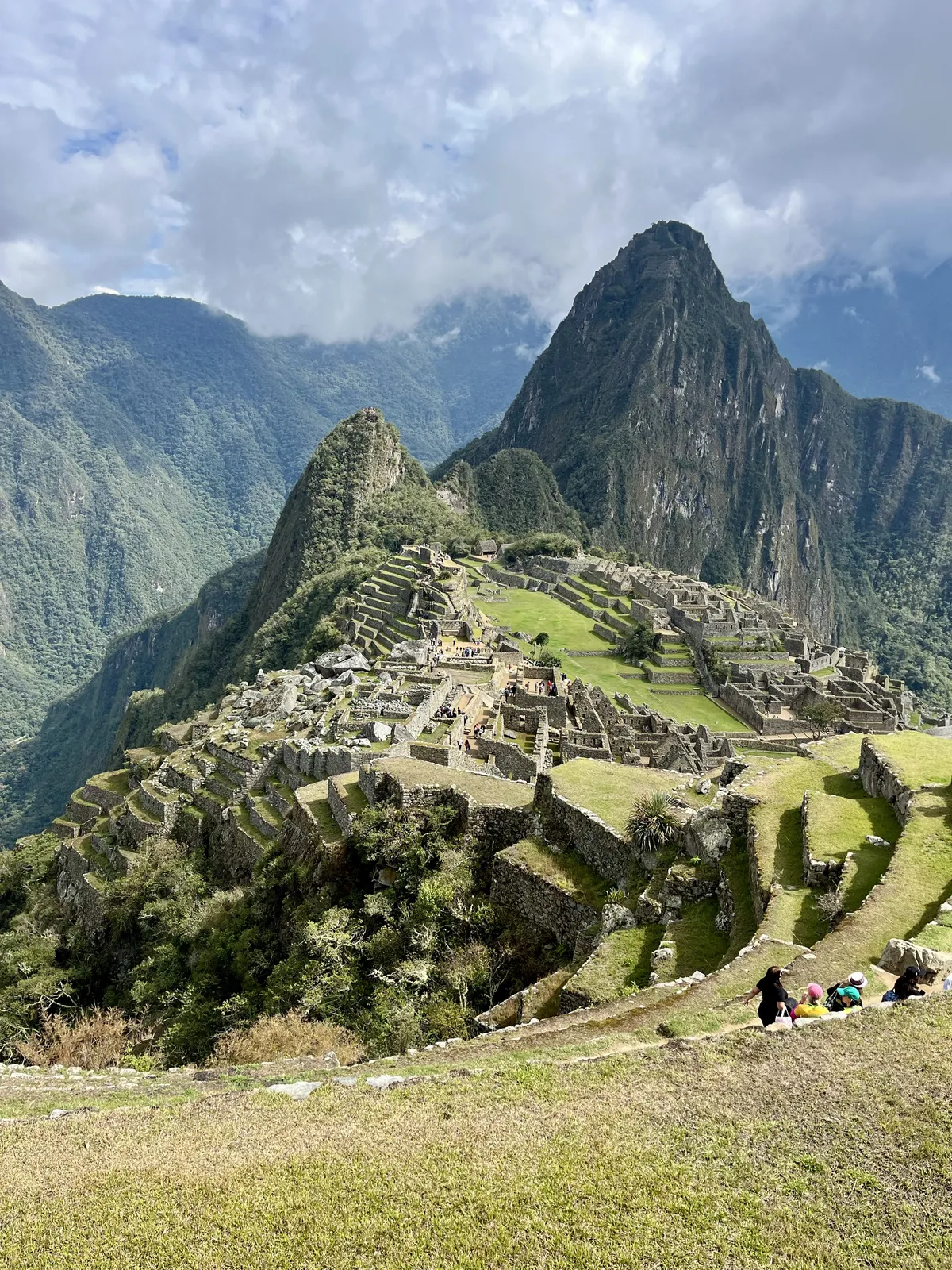
Getting up in the dark and hiking with a headlamp to Intipunku — the Sun Gate. And then — dawn. Machu Picchu, opening up from above, is exactly the view you walk four days for. After the guide’s tour of the city itself, you take the bus down to Aguas Calientes, and the evening train brings you back to Cusco. Your first night after four in tents you’ll sleep in a bed — and believe me, it will never look so good.
| Day | Distance | Highest point | Highlight |
|---|---|---|---|
| 1 | ~12 km | — | Llactapata, warm-up |
| 2 | ~11 km | 4,215 m | Dead Woman’s Pass |
| 3 | ~14 km | — | Cloud forest, Wiñay Wayna |
| 4 | — | — | Sun Gate, Machu Picchu |

How to prepare physically
The Inca Trail isn’t an extreme hike, but it does need basic fitness. You cover 12–16 km a day, and the altitude reaches up to 4,215 metres at Dead Woman’s Pass. The good news is that you can prepare at home, without any expensive equipment — it’s enough to start 2–3 months ahead.
- Regular longer walks of 8–15 km with a backpack weighing about 7–10 kg — so the body gets used to the load
- Stairs instead of the lift every day — the Inca Trail is an endless run of stone steps, and your legs will feel it
- If possible — at least one real hike in the mountains before the trip
And one tip you’ll truly regret forgetting: buy your trekking boots in advance and break them in before the trip. New boots on the Inca Trail mean blisters, and blisters on the second day while climbing to the 4,215-metre pass are real suffering. The same boots you wore for a month at home will be your best friends on the trail.

Altitude — the key topic you mustn’t ignore
However good your fitness, altitude is a separate story. Altitude sickness (locals call it soroche) comes from the reduced oxygen in the air and has nothing to do with fitness — a superb athlete can suffer, while an office worker feels fine. It’s a bit of a lottery, but a lottery you can manage. Symptoms usually begin within 6–12 hours of arriving at altitude: headache, nausea, insomnia, breathlessness.
The essential thing — acclimatise in Cusco (3,400 m) before the trail. On your first day arriving in Cusco it’s best to plan nothing: rest, drink plenty of water, avoid alcohol and move slowly. The local coca tea helps and is often offered free in Cusco hotels — drink it freely. There’s also a prescription drug, acetazolamide (Diamox), which you start taking 1–2 days before arriving at altitude, but be sure to consult a doctor about it in advance. This whole topic deserves its own read — we’ve gathered it into a guide on altitude sickness in Peru and how to acclimatise.
On the trail the rule is simple: tell your guide about any symptoms. The second day’s summit is windy, cold, and the UV very intense — warm clothing and sunscreen are essential. And remember one thing: if your body demands you descend lower, the right to do so isn’t a failure. It’s a sensible decision, and proper Peru travel insurance with mountain activities also covers evacuation from high altitude, should it come to that.

What to pack
The porters take up to about 7 kg of your luggage, and everything else travels on your back for four days. So the daypack (about 30–40 litres) must be light but full of what you really need. Here are the essentials specific to the Inca Trail:
- A rain poncho or a backpack rain cover — mountain weather changes fast
- A headlamp with batteries — essential on the last day, when you set out at 3:30 a.m. in the dark
- Trekking poles — a big help on the descent down the stone stairs; can be rented in Cusco
- Small cash — for the toilets along the way (~1–2 soles) and tips at the end
- Sunscreen SPF50+ and a lip balm with SPF — at altitude the UV intensity is highest
- A warm hat and layered clothing — nights in the tents are cold
- A power bank — there’ll be no electricity at the camps for four days
- A sleeping bag — often rentable through the agency, so confirm in advance

Alternatives if you didn’t get a permit in time
Say you hit reality: you want June, but the permits are already sold out. Or your date falls in February, when the trail is closed. It’s not the end of the world — there are other roads to Machu Picchu.
The simplest alternative is the train. Machu Picchu isn’t reachable by car, but from Cusco or Ollantaytambo you can take the railway to Aguas Calientes, and from there the bus up to the entrance. This doesn’t require a permit half a year ahead — you can buy the train and Machu Picchu tickets yourself. We describe this whole option in detail in how to reach Machu Picchu independently — from railway operators to ticket time slots.
It’s also worth knowing that Machu Picchu tickets work on a time-management system: since 2019, the ticket must be bought for a specific time slot — morning (6:00–12:00) or afternoon (12:00–17:30). The number of spots in each slot is limited, so even travelling by train it’s best to buy 2–4 months ahead, and only through the official site machupicchu.gob.pe, not through resellers with markups.
The Inca Trail doesn’t change all this context — it stays unique in that you enter Machu Picchu on foot through the Sun Gate at dawn, rather than stepping off a bus. But if there’s no room left for the hike, the train lets you see the same wonder without four days in tents.
How the Inca Trail fits into a whole Peru trip
The hike is usually not a separate trip but four days within a bigger route. Typically before the trail you spend a couple of days in Cusco acclimatising and getting to know the Inca heritage, and after the hike you can continue to Humantay Lake, the Rainbow Mountain hike from Cusco, or even the Amazon jungle. Logistics matter here: the international flight to Lima is smart to buy 3–5 months ahead, and the domestic Lima–Cusco flight is best planned so at least 4–5 hours of buffer remain between them, since flights to Cusco are often delayed due to mountain weather.
If you want to see how all this comes together into one route — from flights and acclimatisation to the hike and what follows — see our main Peru guide with Machu Picchu, the Amazon and practical tips. The Inca Trail is the heart of that route, but no less impressive things fit around it.
FAQ
Can you hike the Inca Trail without an agency, on your own?
No. The Inca Trail can’t be hiked independently — the permit is booked in your name only by a licensed agency, and you must have a guide and porters along. It’s not a trail you’d walk alone with a map; all the logistics are handled through an operator.
How far in advance do you need to book a permit?
3–6 months ahead. In the most popular season (June–August) permits sell out within minutes of sales opening, so it’s worth having your agency and deposit ready even earlier, so it can book a spot for your date.
How much does the four-day hike cost?
About 800–1,400 USD ≈ 1 250 €. The price includes the permit, the Machu Picchu ticket, transport, a guide, porters, tents, sleeping bags and all meals. Separately you’ll add tips (~20–30 USD ≈ 25 €), toilet fees along the way, and the bus between Aguas Calientes and Machu Picchu (~12 USD ≈ 11 €).
What’s the highest point and is it hard?
The highest point is Dead Woman’s Pass, 4,215 metres, reached on the second day. The hike isn’t extreme, but you need basic fitness: you cover 12–16 km a day. The biggest challenge is usually not the legs but the altitude, so acclimatising in Cusco before the trail is important.
Can the permit be transferred to another person?
No. The permit is registered against a passport number and is non-transferable. The name on the permit must match the passport you’ll show at the control post at the trailhead, so book with the same passport you’ll fly on.
What do I do if I want to hike in February?
In February the Inca Trail closes for trail maintenance, so there’s no hike that month. Two options: choose another month (the best season is May–October) or reach Machu Picchu by train, which requires no permit half a year ahead.
The Inca Trail isn’t the fastest way to Machu Picchu — but it’s the only one that turns arriving at the city into a four-day experience rather than a single morning’s excursion. Start with the permit, find a good agency early, prepare your legs and lungs — and that dawn view through the Sun Gate will pay you back for every stone step.
Search for flights here. If something goes wrong with your flights, you can claim compensation through AirHelp or Compensair.
Staying connected? Skip expensive roaming and grab an eSIM plan — set it up before you fly and you’ll have data the moment you land.
I always recommend booking taxi transfers to and from the airports in advance. You can do that here.
Find accommodation here.
Travel Without Chaos: Peru — Classic 20-Day Itinerary Without a Car (+ Inca Trail)
Classic 20-Day Trip to Peru — Complete PDF Guide