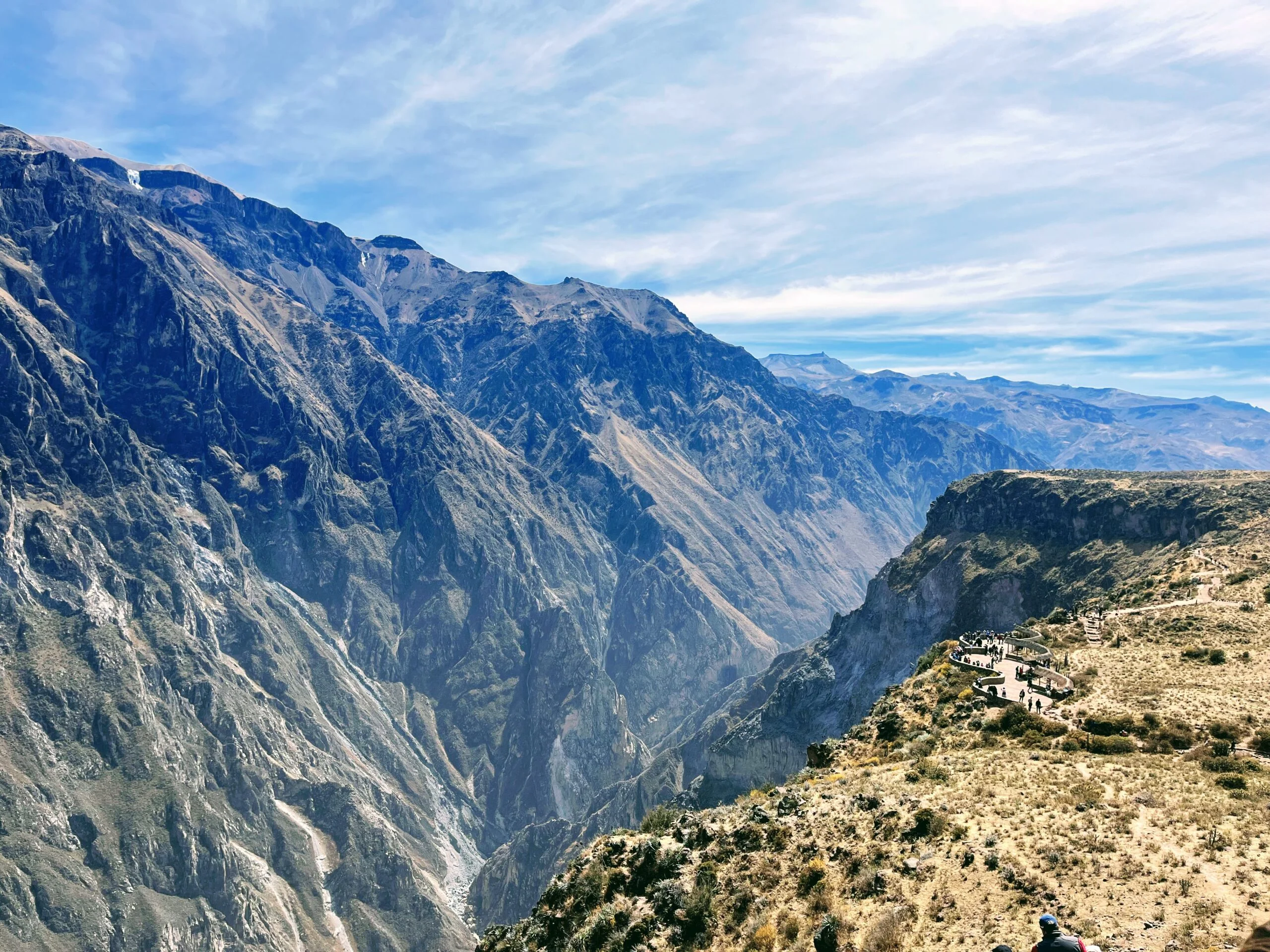
Colca Canyon (Cañón del Colca, or simply Colca Canyon as you’ll often find it in English) is one of the deepest canyons in the world. The numbers speak for themselves: about 3,270 m deep — twice as much as the US Grand Canyon (1,857 m). And yet several times fewer people know about it. That’s where all the magic is.
Some links in this article are affiliate links. If you book through them I earn a small commission, at no extra cost to you.
Contents
- What is Colca Canyon and why is it so special?
- Colca Canyon: a day trip or a multi-day trek?
- 1-day trip from Arequipa
- 2-day trek (the most popular option)
- 3-day trek
- A quick comparison in a table
- Condor-watching: Cruz del Condor
- How to get to Colca Canyon from Arequipa
- Bus from Arequipa (the cheapest option)
- Organised tour
- Private transport / taxi
- The road and what you'll see along the way
- Where to stay in Colca Canyon
- Chivay — the main town
- Cabanaconde — the trekkers' base
- The oasis (Sangalle) — on the canyon floor
- What to pack for the Colca Canyon trek
- Essential
- Not essential, but very useful
- Altitude sickness in Colca Canyon — what to know
- The best time to travel to Colca Canyon
- The La Calera hot springs near Chivay
- Colca Canyon prices: how much does everything cost?
- Frequently asked questions (FAQ)
- In closing
I’m writing this article for those who want to: a) understand whether it’s worth going here (spoiler — yes), b) plan a trek or day trip on their own, c) know what to expect and how much it costs. You’ll find everything — from the Colca Canyon trek routes to condor-watching times and specific prices.
If you haven’t read my article about Arequipa yet — start with it, because Arequipa is the base for the trip to the canyon: Arequipa: what to see in the white city of Peru (on your own). And if you’re planning a wider trip — read about Machu Picchu, the Amazon and practical tips.
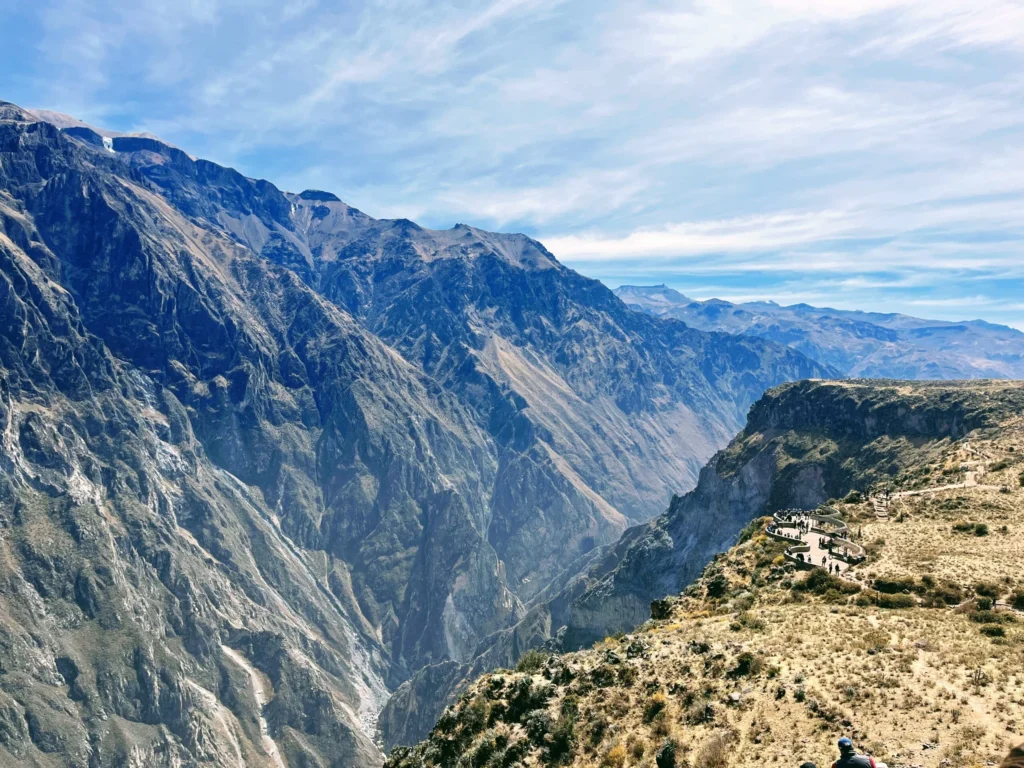
What is Colca Canyon and why is it so special?
The Colca Canyon is in the southern part of Peru, in the Arequipa region, about 160 km northwest of the city of Arequipa. It was shaped over thousands of years by the Colca River — and it did so with such determination that the result is shocking.
Measured officially from the canyon rim to the river, the depth reaches about 3,270 m. Some sources give even 4,160 m, counting from the highest surrounding peaks. Either way — it’s twice as deep as the Grand Canyon in the US. And several times less known — which means fewer tourists and more authenticity.
The Colca valley is part of a UNESCO biosphere reserve. Here flies the Andean condor — one of the largest flying birds in the world, with a wingspan of up to 3.2 m and a weight of up to 15 kg. And here you can see them not through binoculars — but right above your head.
But the canyon is not just nature. In the valley still live the Cabana and Collagua ethnic groups with traditional clothing and embroidered hats. Inca and pre-Inca terraced fields — some used for farming to this day. It’s a living, breathing landscape.
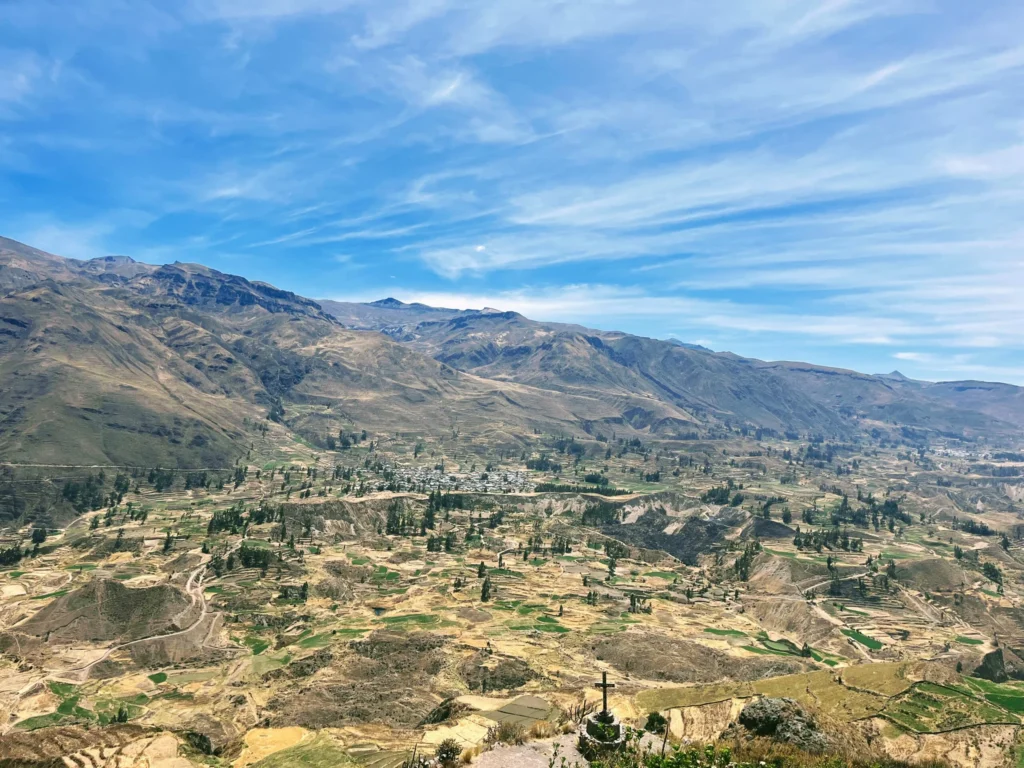
Colca Canyon: a day trip or a multi-day trek?
That’s the first question everyone asks. The answer depends on your time, fitness and what you want to feel. Here are three options — from the easiest to the “your legs won’t thank you.”
1-day trip from Arequipa
Who it suits: those with little time or who don’t want to trek.
What you’ll see: Cruz del Condor (the condor viewpoint), the town of Chivay, canyon panoramas, a stop by a herd of vicuñas in the Pampa Cañahuas reserve, the La Calera hot springs.
Typical schedule: departure 3:00–4:00 a.m. from Arequipa, return ~17:00–18:00. A long day — about 6 hours of road there and back. In between — stops and views.
Price:
- Group tour: 40–80 PEN ≈ 20 € (10–20 EUR) — but this is only transport and a guide
- Tourist ticket (Boleto Turístico): 70 PEN ≈ 18 € (~18 EUR) for foreigners — paid separately
- La Calera hot springs: 15 PEN ≈ 4 € (~4 EUR) extra
- Lunch: 15–40 PEN ≈ 10 €
Is it worth it? You’ll see the canyon and the condors, but you won’t descend inside — it’s like looking at a pool but not swimming. If you have only one day — still better than nothing. But if you can give more time…
2-day trek (the most popular option)
Who it suits: those wanting to experience the canyon from the inside but with limited time.
Route: Cabanaconde → descent to the canyon floor → overnight at the Sangalle oasis → an early climb back.
Descent: ~1,100 m down over ~3 hours. The trail is clear, in places steep, but walkable. The paths are dusty in the dry season — lace your boots tightly.
Climb back: ~1,100 m up over 3–4 hours. This is the hardest part. Start at 4:00–5:00 a.m., while it’s cool — otherwise the midday sun will “eat you alive.”
The oasis (Sangalle): a real oasis on the canyon floor — palm trees, simple huts, pools. At night — a starry sky you’ll never see in a city. Accommodation from 15–30 PEN ≈ 8 €, with a private bathroom about 40 PEN ≈ 10 €.
With a guide or on your own? Both options work perfectly. The trail is marked, and many trekkers go independently. But if you go alone — have an offline map (maps.me or AllTrails) and tell your hotel your plan.
Price on your own:
Accommodation at the oasis: 20–40 PEN ≈ 10 €
Food in the canyon: 25–50 PEN ≈ 13 €/day
Tourist ticket: 70 PEN ≈ 18 €
Bus Arequipa–Cabanaconde: ~25 PEN ≈ 6 €
Total: ~140–185 PEN ≈ 50 € (~35–47 EUR) without return transport
3-day trek
Who it suits: those in no rush and wanting to see more than just “up and down.”
Route: Cabanaconde → San Juan de Chuccho → Oasis/Sangalle → back to Cabanaconde. Or with detours through the Tapay, Cosñirhua villages — where tourists almost never go.
The advantage: you see the real life of the canyon — villages with a bread oven in the yard, locals with llamas, Inca terraces with growing corn. The trail lets you stop, breathe, not regret the pace.
The climb on the last day is still hard — but you have more strength, because you didn’t rush and slept two nights, not one.
A quick comparison in a table
| Option | Duration | Difficulty | Price (approx.) | Suits |
|---|---|---|---|---|
| 1-day trip | 14–16 h | Easy | 25–50 EUR | Little time, don’t want to trek |
| 2-day trek | 2 d / 1 n | Medium–hard | 40–80 EUR | Those wanting to experience the canyon |
| 3-day trek | 3 d / 2 n | Medium | 60–120 EUR | Those in no rush, adventure seekers |
Condor-watching: Cruz del Condor
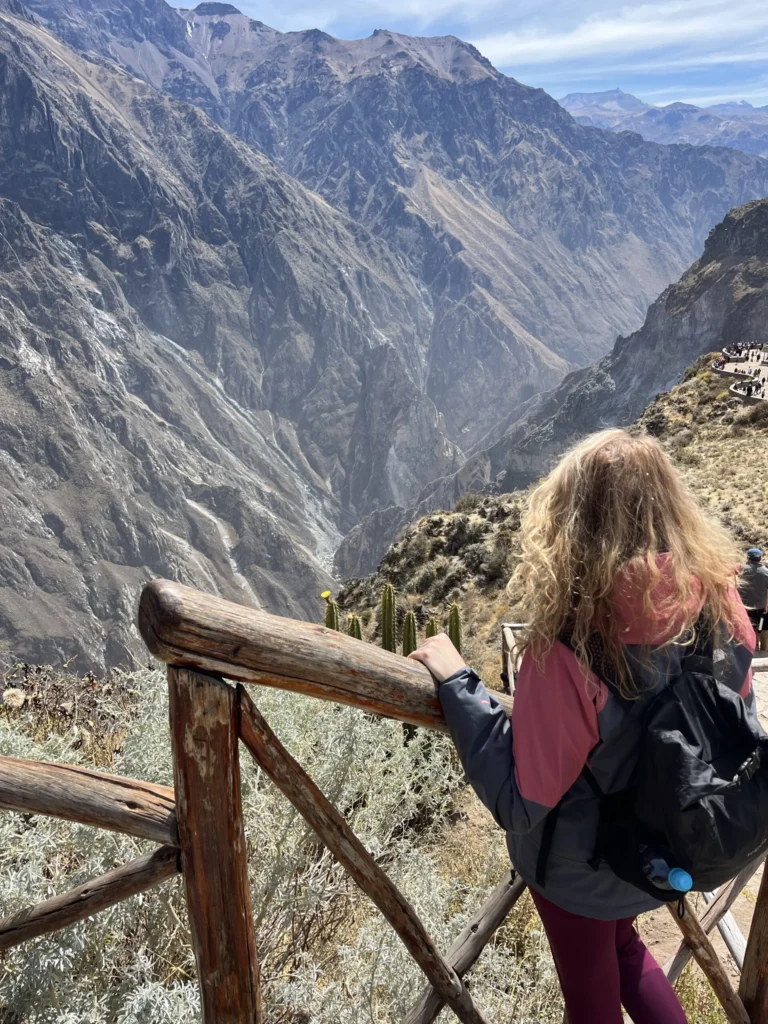
If the canyon is a stage — then the condors are its main actors. And Cruz del Condor is the best place to see them on the whole South American continent.
How it happens: in the morning, when the sun warms the rock walls, warm air currents rise. The condors know this. They rise from the depths of the canyon and fly upward — sometimes just a few metres above the viewing platform. The Andean condor’s wingspan reaches up to 3.2 m — that’s almost like a small car. And they fly completely silently. No flapping of wings — just gliding on the wind.
Best time: 8:00–10:00 a.m. The dry season (April–November) is ideal, because the sky is clear and the air currents stronger.
How many will you see? On a good day — 5–15 condors. Sometimes just 1–2. Nature doesn’t guarantee, but the odds in the dry season are really good. I saw 3 — and every time a new one appeared, my heart still leapt.
Tip: arrive before the tourist buses — they usually come around 9:00. If you stay in Cabanaconde (only ~30 min drive), you’re closer and can come first, take the best spot.
Important to know: the Andean condor is an endangered species. Only about 6,700 adults remain in the wild. Watching from the viewpoint doesn’t disturb them — it’s sustainable, responsible tourism. But respect their space — no drones, no shouting, just watch.
How to get to Colca Canyon from Arequipa
Colca Canyon from Arequipa is about 160 km, but on mountain roads it takes longer than you’d expect. Here are all the options.
Bus from Arequipa (the cheapest option)
Direction: Arequipa → Chivay (~3–3.5 h) or Arequipa → Cabanaconde (~5–6 h).
From where: the Arequipa bus terminal (Terminal Terrestre).
Companies: Reyna, Andalucía, Transandino. Tickets Arequipa–Chivay: 25–35 PEN ≈ 9 € (6–9 EUR), Arequipa–Cabanaconde: ~25 PEN ≈ 6 € (6 EUR).
Frequency: several buses a day — most leave at midday (12:00–14:00).
Tip: sit on the left side (heading toward Chivay) — better views out the window! Along the way you’ll see volcano panoramas and vicuña herds.
Organised tour
Booking in Arequipa — easier than buying a coffee. Dozens of agencies around Plaza de Armas offer tours to Colca Canyon. The starting price is 60–80 PEN ≈ 20 € (a 1-day tour), but you can haggle down to 40–50 PEN ≈ 13 €.
Online (GetYourGuide, Viator) — more expensive (from ~40 USD ≈ 35 €), but with a cancellation option.
What’s included: transport, a guide (Spanish + English). NOT the tourist ticket (70 PEN ≈ 18 €), NOT the hot springs (15 PEN ≈ 4 €), NOT lunch.
Private transport / taxi
You can hire a driver for the whole day: ~200–300 PEN ≈ 80 € (50–75 EUR). Worth it if you travel as 3–4 people — the price is split, and you stop where you want and for as long as you want.
The road and what you’ll see along the way
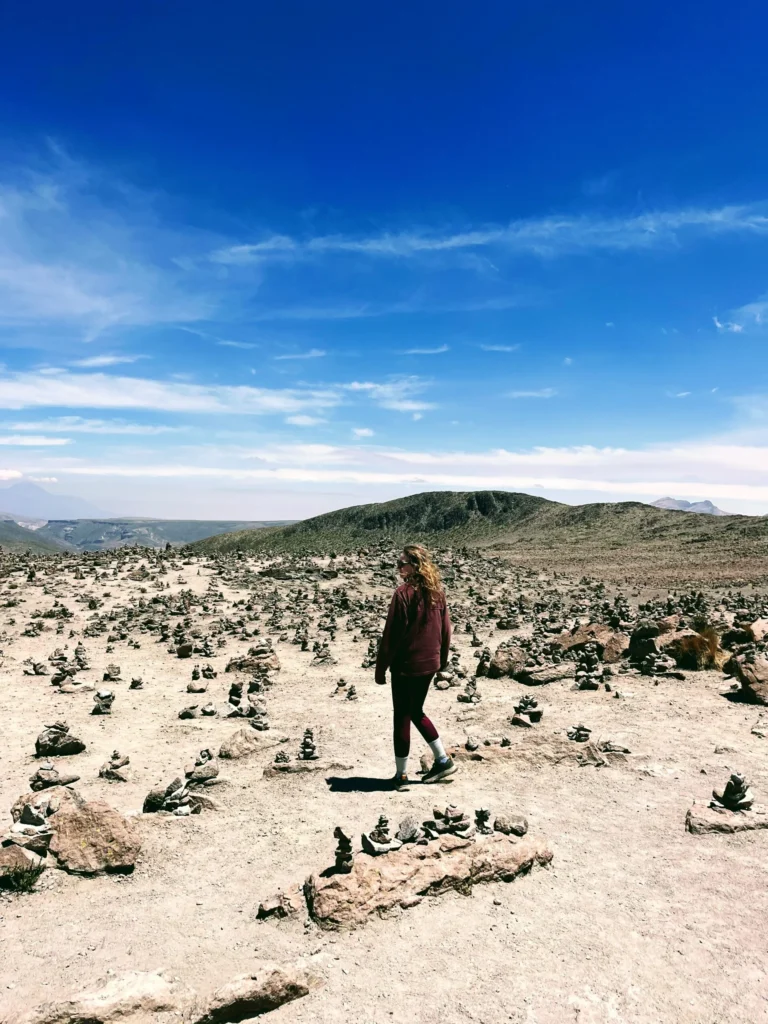
The road Arequipa → Chivay goes over the Patapampa pass — 4,910 m! That’s the highest point on the whole route. Here the buses often stop for photos. The air is cold, the wind cuts, but the view is cosmic.
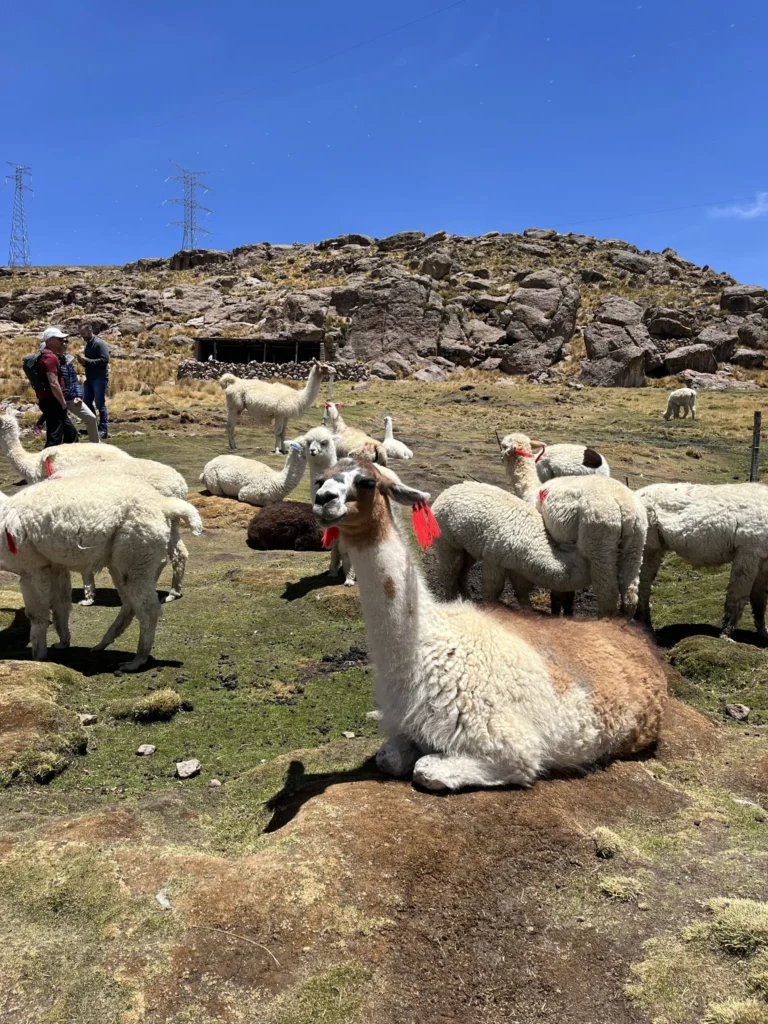
Along the way you’ll see vicuña herds (wild relatives of the llama, the most beautiful of all the camelids), the Pampa Cañahuas national reserve and volcanic landscapes that take your breath away.
WARNING about altitude: the pass is nearly 5,000 m! If you’re not acclimatised — you may feel unwell. Don’t drink alcohol before the trip, drink plenty of water, have coca sweets.
Where to stay in Colca Canyon
Chivay — the main town
The biggest and most touristy town at the start of the canyon. The most choice: hostels, hotels, restaurants, ATMs (the only ones in the whole canyon!).
From here it’s only ~15 min by transport to the La Calera hot springs (15 PEN ≈ 4 € entry, open 5:00–19:00). After a trek or a long bus journey — it’s a real paradise.
Prices: hostel 25–50 PEN ≈ 13 € (6–13 EUR), hotel 80–180 PEN ≈ 45 € (20–45 EUR).
Suits: if you plan a 1-day trip or want comfort before/after the trek.
Cabanaconde — the trekkers’ base
Smaller, quieter, “more real.” The trek to the canyon floor starts here. The atmosphere is like a time-stopped Andean village.
A few simple hostels and guesthouses (20–60 PEN ≈ 16 €). Local eateries with a menú del día — 8–12 PEN ≈ 3 € (~2–3 EUR) for a full lunch. Yes, for two euros!
Tip: stay here before the trek so you can leave early in the morning (4:00–5:00). And fill up on water — in the canyon it’ll cost double.
The oasis (Sangalle) — on the canyon floor
This is one of the strangest places I’ve ever stayed. Palm trees on the canyon floor, simple bamboo huts, pools (some solar-heated). At night — such silence and such stars that you just want to lie down and look.
Electricity is limited — in places only in the evenings. Charge your phone in Cabanaconde before the trek!
Price: accommodation — 15–40 PEN ≈ 10 € (4–10 EUR), dinner + breakfast — 25–40 PEN ≈ 10 € (6–10 EUR).
What to pack for the Colca Canyon trek
The packing list — that boring but vitally important part.
Essential
- ✅ Comfortable, lace-up hiking boots — NOT trainers, NOT sandals! The trail is stony and steep.
- ✅ At least 2–3 litres of water — you can buy it in the canyon, but at double the price
- ✅ Sun protection: SPF50 cream, hat, sunglasses. The sun in the canyon is merciless
- ✅ A warm layer for the evening — on the canyon floor it’s warm by day (~25°C), but the nights are cool (~10°C)
- ✅ A wind/rain jacket — especially in the wet season
- ✅ A torch — the oasis is DARK, and you’ll start the climb at 4 a.m.
- ✅ Cash — there are no ATMs in the canyon (the nearest is Chivay)
- ✅ Toilet paper — the toilets are basic, and paper isn’t always there
- ✅ Snacks: nuts, energy bars, chocolate
- ✅ A first-aid kit: painkillers, plasters, electrolytes
- ✅ A downloaded maps.me or AllTrails map in offline mode — the signal in the canyon is almost zero
Not essential, but very useful
- A camera (a phone works too, but charge it the night before — the oasis may have no electricity!)
- Spare socks — after the descent your feet will be grateful for dry cotton
- Coca leaves or coca sweets — help with altitude sickness, can be bought at any kiosk. It’s NOT a drug — just a natural local remedy
- Light sandals for the oasis — after the trek your feet want freedom
Altitude sickness in Colca Canyon — what to know
Altitude sickness in Peru needs to be taken seriously — especially in Colca Canyon, where the altitude constantly changes.
Altitude map:
- Chivay: 3,635 m
- Cabanaconde: 3,287 m
- Patapampa pass (on the way): 4,910 m!
- The canyon floor (Sangalle oasis): ~2,100 m — here it’s easier to breathe
The biggest risk: the pass on the way from Arequipa (nearly 5,000 m — here the headache and nausea peak) and the climb from the canyon floor back up (from 2,100 m to 3,287 m over 3–4 hours in the early morning, when the body is still asleep).
Symptoms: headache, nausea, breathlessness, insomnia, weakness.
What to do:
- Acclimatise in Arequipa (2,335 m) for at least 1–2 days BEFORE the trip to the canyon
- Drink 3–4 litres of water a day (more than you think you need)
- Coca tea (mate de coca) — a locally proven method
- Diamox (acetazolamide) — some travellers use it prophylactically, but consult a doctor before the trip
- Don’t eat heavy food or drink alcohol before and during the trek
- If symptoms are strong — descend. It’s the only real cure. The body at altitude doesn’t go along with “I’ll sit and it’ll pass”
The good news — on the canyon floor (at the oasis) you’ll feel much better than up top. The bad — the next morning you’ll have to climb back up.
The best time to travel to Colca Canyon
Dry season (April–November): the best. Clear skies, almost no rain, condors more active due to stronger warm air currents. The trails are dry and not dangerous. But the nights are the coldest (down to 0°C or below in Chivay). A warm sleeping bag or jumper — a must.
Wet season (December–March): the trails are slippery, it can be cloudy, condors less visible. BUT — everything is green and wonderful, fewer tourists, cheaper hotels. The rains are usually short, in the afternoons — in the morning the sky is still clear.
Ideal time: May–September — the driest, the clearest skies, the highest chance of seeing condors. But also the coldest nights — be ready to layer up.
My advice: if your travel dates don’t let you choose — any month works. Even in the wet season Colca Canyon is impressive. I was there in October — and it was perfect.
The La Calera hot springs near Chivay
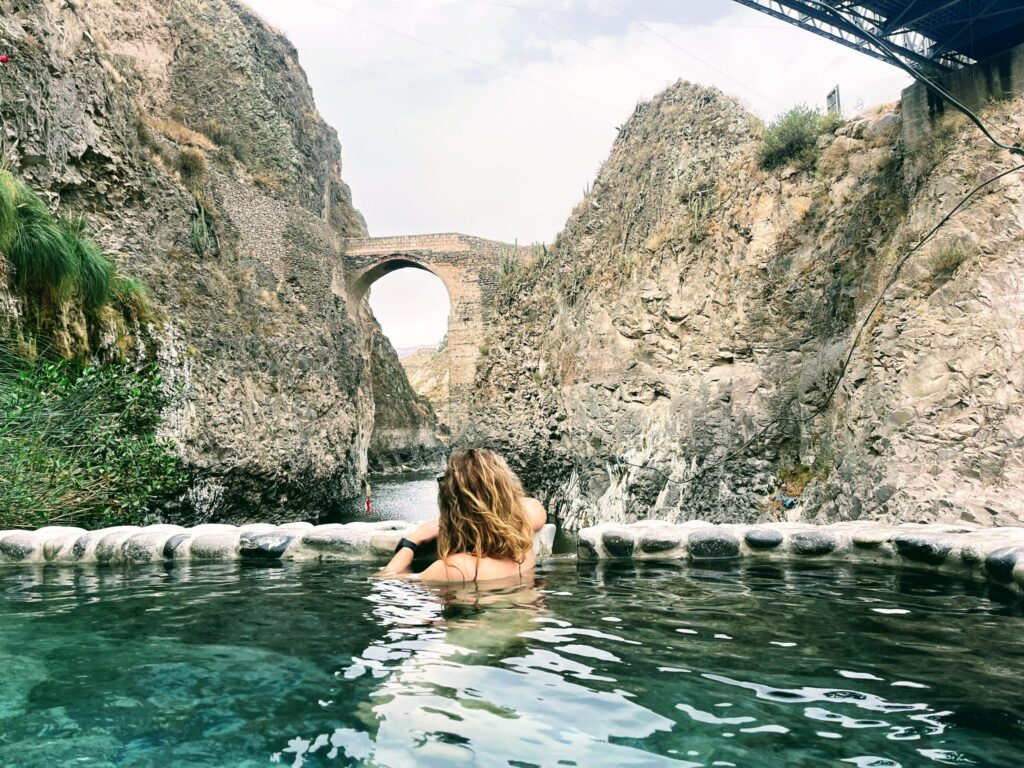
The La Calera hot springs are pools of thermal water, located ~3 km from Chivay, on the edge of the canyon.
The water is naturally warm (~38°C), several pools of different depths. You sit in the heat, mountains all around, the sky blue, your feet say thank you. After a canyon trek — it’s better than any spa.
Practical info:
- Entry: 15 PEN ≈ 4 € (~4 EUR)
- Opening hours: 5:00–19:00
- How to get there: shared transport from Chivay (~5 PEN ≈ 1 €) or on foot (~40 min)
- There are changing rooms, but no towels provided — bring your own
- Tip: go early in the morning or late afternoon — fewer people
Colca Canyon prices: how much does everything cost?
A Colca Canyon summary — so you can plan your budget:
| Expense | Price (PEN) | Price (EUR) |
|---|---|---|
| Tourist ticket (Boleto Turístico) | 70 PEN ≈ 18 € | ~18 EUR |
| Bus Arequipa → Chivay | 25–35 PEN ≈ 9 € | 6–9 EUR |
| Bus Arequipa → Cabanaconde | ~25 PEN ≈ 6 € | ~6 EUR |
| Accommodation in Cabanaconde (hostel) | 20–60 PEN ≈ 16 € | 5–15 EUR |
| Accommodation at the oasis (Sangalle) | 15–40 PEN ≈ 10 € | 4–10 EUR |
| Food at the oasis (dinner + breakfast) | 25–40 PEN ≈ 10 € | 6–10 EUR |
| Food in Cabanaconde (menú del día) | 8–12 PEN ≈ 3 € | 2–3 EUR |
| La Calera hot springs | 15 PEN ≈ 4 € | ~4 EUR |
| 1-day organised tour | 40–80 PEN ≈ 20 € | 10–20 EUR |
Exchange rate: 1 EUR ≈ 3.96 PEN ≈ 1 € (March 2026).
Rough budget for a 2-day trek (on your own): about 170–260 PEN ≈ 65 € (~43–66 EUR) — with transport, accommodation, food and the ticket. It’s one of the cheapest epic treks in the world.
Frequently asked questions (FAQ)
Can you go to Colca Canyon without a guide?
Yes! The trail from Cabanaconde to the Sangalle oasis is marked, and many trekkers go Colca Canyon independently. But have a downloaded offline map (maps.me or AllTrails) and tell your hotel your plan.
How much does Colca Canyon cost?
The tourist ticket (Boleto Turístico): 70 PEN ≈ 18 € (~18 EUR) for foreigners. An independent trek (2 days): about 170–260 PEN (43–66 EUR) with accommodation, food and transport. With an organised tour: 150–400 PEN (38–100 EUR) depending on the duration and comfort level.
Is Colca Canyon a hard trek?
The descent is of medium difficulty, walkable for most. The climb is hard: 1,100 m up over 3–4 hours. But if you’re at least moderately fit and acclimatised for at least 1–2 days in Arequipa — it’s definitely doable. Start early in the morning, while it’s cool.
When is the best time to visit Colca Canyon?
The dry season: April–November. The best for condor-watching and trekking. Most ideal: May–September. But even in the wet season (December–March) the canyon can be visited — just the trails are more slippery and there’s more cloud.
Is it worth going to Colca Canyon with children?
A 1-day trip — yes, suitable for older children (from ~8 years). The trek to the canyon floor — only with teenagers and good fitness. The climb is a serious challenge even for adults.
Where to buy the tourist ticket?
At the entrance to the canyon (control posts near Chivay or along the way) or in Arequipa during a tour — the guide often buys it, but the ticket price (70 PEN) is added to the tour price separately.
In closing
Colca Canyon is one of those Peru wonders not yet swamped by tourists. And seeing such majestic birds is a must.
👉 Planning a whole Peru trip? Read about Machu Picchu, the Amazon and practical tips.
👉 Want to learn about Arequipa? Read about Arequipa: what to see in the white city of Peru on your own.
Search for flights here. If something goes wrong with your flights, you can claim compensation through AirHelp or Compensair.
Staying connected? Skip expensive roaming and grab an eSIM plan — set it up before you fly and you’ll have data the moment you land.
I always recommend booking taxi transfers to and from the airports in advance. You can do that here.
Find accommodation here.
Travel Without Chaos: Peru — Classic 20-Day Itinerary Without a Car (+ Inca Trail)
Classic 20-Day Trip to Peru — Complete PDF Guide