One of the most common questions I get about Peru is: do you need a visa? The short answer: NO. But there are a few things you really should know before the trip. And no, “my passport is valid” doesn’t yet mean you’ve sorted everything out.
Some links in this article are affiliate links. If you book through them I earn a small commission, at no extra cost to you.
Contents
- Short answer: do you need a visa for Peru?
- What documents do you need for a trip to Peru?
- 1. Passport (required)
- 2. Return ticket or onward ticket out of Peru (recommended)
- 3. Travel insurance (strongly recommended)
- 4. COVID-19 requirements (2026)
- 5. Yellow fever vaccine (mandatory in some cases)
- TAM — Peru's digital migration card
- How many days can you stay in Peru without a visa?
- Practical tips at Lima airport (Jorge Chávez)
- Arrival and immigration
- Luggage and customs
- SIM card and internet
- Transport from the airport
- Money in Peru: currency, payments, ATMs
- Peru's currency
- ATMs
- Card payments
- Safety in Peru: what to know
- The general situation
- Main rules
- Emergency numbers
- Peru vaccinations and health: what to know before the trip
- Recommended vaccinations
- "Peru belly" — how to avoid it
- Flights to Peru
- Useful contacts and links
- Frequently asked questions (FAQ)
- Conclusion: Peru is waiting — and it's easier than you think
This article is for EU, UK and most Western passport holders planning an independent trip to Peru. The information was updated in March 2026 — but since rules can change, I always recommend checking officially before your flight.
⚠️ Important: this information is based on my own experience and official sources. Rules can change — always check the Peruvian immigration service’s website or peru.travel before you travel.
If you already know you don’t need a visa — great! And if you still haven’t decided whether Peru is for you, read my articles on Arequipa and Colca Canyon. You might decide faster than you think.

Short answer: do you need a visa for Peru?
NO. Citizens of the EU, the UK, the US, Canada, Australia and most Western countries do NOT need a visa for Peru for tourism.
Peru has waived the visa requirement for citizens of these countries. That means — with a valid passport you simply fly in, arrive, and receive permission to stay in the country.
Permitted stay: up to 183 days within a 365-day period — that’s the maximum. But in practice the immigration officer (Migraciones) most often grants 90 days.
An important note: the number of days is set by the officer on arrival. It could be 90, it could be 60, it could be 183 — it’s their decision. So when you arrive, ask them to tell you clearly, or check it on your digital TAM card (more on that below).
What documents do you need for a trip to Peru?
1. Passport (required)
Your passport is the only document that gets you into Peru. A national ID card is NOT accepted — even if it’s valid and you’re an EU citizen.
Requirements:
- The passport must be valid for at least 6 months from the date of arrival in Peru
- It must have at least 1–2 blank pages (for stamps)
- A biometric passport isn’t mandatory, but it’s recommended (faster control)
Tip: check your passport’s validity BEFORE buying tickets. If it expires within 6 months — renew it. This is the most common mistake travellers make.
2. Return ticket or onward ticket out of Peru (recommended)
Officially, Peru requires you to have a return ticket or a ticket to another country.
In practice: it isn’t always checked. But they CAN ask — both the airline before boarding and the immigration officer at the Peruvian airport.
If your trip is open-ended (you don’t know the date):
- You can buy a cheap bus ticket to Bolivia or Ecuador
- Or use a service like onwardticket.com (a temporary ticket ~$15 ≈ 13 € USD)
I had a return ticket and nobody checked.
3. Travel insurance (strongly recommended)
Peru does NOT officially require travel insurance. All COVID-related requirements were dropped back in 2023.
BUT — it’s strongly recommended to have insurance that covers:
✅ Medical expenses (Peruvian hospitals can be very expensive!) ✅ High-altitude evacuation (if you’re planning mountain treks, this is a must) ✅ Lost luggage (especially with connections) ✅ Trip cancellation
Important: check whether the policy covers activities above 3,000 m and trekking — not all do! Peru is a mountain country, and if you’re at 3,400 m in Cusco, that’s already not a standard situation for many insurers.
Insurance is the thing you hope you’ll never need. But when you do — it’s priceless. In the Peruvian mountains it’s not a luxury, it’s a necessity.
4. COVID-19 requirements (2026)
Since 2023 Peru does NOT require any COVID-19-related documents: no vaccination pass, no test, no health declaration.
But note: this can change. Before your trip, always check the official Peru tourism site or gob.pe.
5. Yellow fever vaccine (mandatory in some cases)
If you’re travelling ONLY around the mountain region (Lima, Arequipa, Cusco, Machu Picchu) — the yellow fever vaccine is NOT required.
BUT if you plan to go into the Amazon jungle (Puerto Maldonado, Iquitos, Manú National Park) — the yellow fever vaccine is MANDATORY.
Where to get vaccinated: at a travel medicine clinic in your own country. Most large cities have a travel health centre or a tropical medicine clinic that offers this.
You need to be vaccinated at least 10 days BEFORE the trip. Bring your international certificate of vaccination (the yellow card) with you!
I got vaccinated because I was planning the jungle. It cost about €25–30. Everything went smoothly.
TAM — Peru’s digital migration card
This section is really important, because many older sources still write about the paper form you used to fill in on the plane. Forget that — everything has changed.
What is TAM? Tarjeta Andina de Migración (the Andean Migration Card) — a mandatory immigration document for everyone entering Peru.
What’s new: TAM is now DIGITAL (TAM Virtual). You no longer fill in any paper form on the plane!
How it works:
- When you arrive at a Peruvian airport, the immigration officer scans your passport
- The system automatically creates a digital TAM
- The TAM records: your arrival date, the number of days granted, and your migration status
- You can download your TAM as a PDF from the Migraciones website
Why it matters: the TAM states HOW MANY DAYS you’re allowed to stay in Peru. Be sure to check your TAM right after arrival — you can download the PDF version to your phone.
Do you need to keep it? Since it’s now digital, you don’t need to keep a physical copy. But it’s recommended to download the PDF to your phone and/or email. It comes in handy if anyone asks (hotels sometimes do).
It used to be that you’d fill in a paper form and guard it like the apple of your eye for the whole trip. Now — it’s all digital. Thank you, Peru, for the progress!
How many days can you stay in Peru without a visa?
This is one of the most common questions about Peru — and the answer isn’t as simple as you’d expect.
The standard rule:
- Maximum: up to 183 days within a 365-day period.
- In practice: the immigration officer decides how many days to give you. Most often — 90 days.
- 2024–2026 trend: officers increasingly grant exactly 90 days (they used to give 183 more often).
What to do if you get fewer days than you want?
On arrival: you can politely ask for more days — say how long you plan to stay and what your route is. Have a return ticket with a date — it helps. But don’t haggle aggressively — the officer has the right to decide. Politeness and a smile work better.
Can you extend your stay in Peru?
- Officially: you can apply to the immigration department for an extension up to the 183-day limit.
- BUT: since 2024 extensions have become more complicated — citizens of Andean Community countries have an easier path than others.
- Alternative: leave Peru (e.g. to Bolivia or Ecuador) and come back. But be careful — the officer may grant fewer days or refuse if they see you’ve already been close to the 183-day limit within 365 days.
Overstay fine: S/ 5.50 ≈ 1 € per day (2026) — that’s 0.1% of the UIT, which in 2026 is S/ 5,500 ≈ 1 450 €. That’s about €1.40 per day — paid on departure. It can cause problems for future trips.
A table for clarity:
| Scenario | Number of days | Note |
|---|---|---|
| Most commonly granted on arrival | 90 days | Officer’s decision |
| Maximum per 365 days | 183 days | Overall yearly limit |
| Extension via immigration department | Up to the 183-day limit | Hard to get since 2024 |
| Overstay fine (2026) | S/ 5.50 ≈ 1 €/day | ~€1.40/day |
Practical tips at Lima airport (Jorge Chávez)
Arrival and immigration
Jorge Chávez International Airport (LIM) — the vast majority of international travellers arrive through it. Important news: since June 2025 a new terminal is in operation — three times bigger than the old one, modernised and much improved.
Immigration queue: it can be long — 20–60 min at peak times. Join the “Extranjeros” (foreigners) queue.
What the officer will ask: usually nothing, or “cuántos días?” (how many days?). Have your answer ready — say something specific: “30 days,” “2 weeks,” or however long you plan to stay.
Passport stamp: in 2026 some booths no longer add a physical stamp — instead everything is recorded in the digital TAM. But some still stamp. Don’t be upset if they don’t — it’s normal.
Luggage and customs
What you can bring in duty-free:
- Personal belongings
- Up to 3 litres of alcohol
- Up to 400 cigarettes or 50 cigars
- Gifts up to $300 ≈ 270 € in value
What you CANNOT bring in: fresh fruit, vegetables, meat, dairy products (strict phytosanitary control). Coca leaves from Bolivia are also a no (even though they’re legal in Peru, importing them isn’t allowed).
Customs declaration: if you have nothing to declare — go through the green channel (nada que declarar). Simple.
SIM card and internet
In the new terminal, right after collecting your luggage, you can buy a SIM card: Claro, Movistar or Entel.
Price: ~20–30 PEN ≈ 8 € (€5–8) for a decent data plan for 2–3 weeks.
My recommendation: use an eSIM service and you won’t need any physical cards. You can try Saily or Airalo — see which plan is better.
First investment in Peru — a SIM card. Second — coca tea. Third — an alpaca wool hat. Priorities.
Transport from the airport
- Official airport taxi: book at the official stand in the terminal. Price to the centre — about 60–80 PEN ≈ 20 € (€15–20)
- DON’T take a taxi off the street — unsafe and more expensive
- Uber / InDrive: works, but you need internet (so first — a SIM card!). Cheaper: 20–40 PEN ≈ 10 €
- Airport Express Lima: a bus to the Miraflores district — 15 PEN ≈ 4 €. The cheapest and most convenient option
Tip: if you arrive at night — take an official taxi. Not the place to save money.
Money in Peru: currency, payments, ATMs
Peru’s currency
The Sol (PEN) — Peru’s national currency. 1 EUR ≈ 3.8–4.0 PEN ≈ 1 € (2026 indicative rate — check the current one before your trip).
Where to exchange: NOT at the airport (bad rate). Better — at city exchange offices (casas de cambio) or just use an ATM. Tip: euros are harder to exchange than dollars. If you have USD — bring them, the rate is better and they’re accepted everywhere.
ATMs
International cards (Visa, Mastercard) work. Revolut and Wise work great in Peruvian ATMs.
Fees: Peruvian ATMs CHARGE a fee — 5–8 PEN ≈ 2 € per transaction. On top of that, your own bank may add its own fee.
Tip: use BCP or Interbank ATMs — the most reliable. Withdraw a larger amount at once (up to 700 PEN ≈ 180 €) to reduce the number of fees.
IMPORTANT: keep cash! In small towns, markets, on buses — cash only.
Card payments
- In Lima, Cusco and Arequipa — cards are accepted in most restaurants and shops
- In small towns, markets and for transport — cash only
- Contactless payments (NFC) — work in larger shops
My “50/50 rule”: keep half your budget on a card, half in cash. It’s never let me down.
Safety in Peru: what to know
The general situation
Peru is a fairly safe country for tourists, especially in tourist areas. Cusco, Arequipa, the Sacred Valley — I felt safe even travelling solo.
Lima is a big city with big-city problems. Safer districts: Miraflores, Barranco, San Isidro. Avoid at night: the old town Centro, Callao, San Juan de Lurigancho.
Main rules
✅ Don’t wear expensive jewellery or carry large amounts of cash ✅ Use an inner pocket or a money belt under your clothes ✅ Taxis — only official ones or via an app (Uber, InDrive) ✅ Guard your phone — don’t hold it out on the street (especially in Lima, at intersections) ✅ Don’t walk down empty streets at night — take a taxi ✅ Luggage on buses — in the hold, not above your head ✅ Copies of documents — in the cloud (Google Drive or similar)
Emergency numbers
| Service | Number | Note |
|---|---|---|
| Police | 105 | General emergency number |
| Tourist police (iPeru) | 01-574-8000 | Very helpful, they speak English! |
| Ambulance | 116 | Free to call |
| EU delegation / your embassy | — | Any EU country’s embassy can help EU citizens |
Important: there isn’t an embassy for every country in Peru. But as an EU citizen you can turn to any EU country’s embassy in Peru for help — that’s guaranteed under EU law. Check whether your own country has an embassy or consulate in Lima before you travel.
Tip: register with your country’s foreign ministry travel-registration service before the trip — that way they’ll know where you are if anything happens.
Peru vaccinations and health: what to know before the trip
Recommended vaccinations
| Vaccine | Status | Note |
|---|---|---|
| Yellow fever | MANDATORY (jungle) | Vaccinate ≥10 days before the trip |
| Hepatitis A | Recommended | Spreads through water and food |
| Hepatitis B | Recommended | If not already vaccinated |
| Tetanus-diphtheria | Update | If it’s been >10 years |
| Typhoid | Recommended | If going to remote areas |
| Malaria | Prophylaxis (jungle) | Malarone or Doxycycline — with a doctor |
| Dengue | No vaccine | Use repellent in the jungle |
“Peru belly” — how to avoid it
- Drink only bottled water (NOT from the tap!)
- Avoid ice cubes (often made from tap water)
- Eat where there are lots of locals (fast turnover = fresh food)
- Don’t brush your teeth with tap water (at least the first few days)
- Carry with you: loperamide, electrolytes, probiotics
Peruvian food is fantastic. Peru belly — not so fantastic. But with a few precautions, everything will be fine.
More about health in the mountains — in my article on altitude sickness in Peru. There you’ll find everything about acclimatisation, Diamox and coca tea.
Flights to Peru
There are no direct flights from most European cities to Lima. But with one connection it’s quite convenient.
The most popular routes from Europe go via:
- Amsterdam (KLM) → Lima
- Madrid (Iberia) → Lima
- Paris CDG (Air France) → Lima
- Frankfurt (Lufthansa / LATAM codeshare) → Lima
- Istanbul (Turkish Airlines) → Lima — longer, but often the cheapest!
Price guide: €600–1,200 (return), depending on the season and airline.
Best prices: buy 3–6 months before the trip. Watch Google Flights, Skyscanner, Momondo. October–November flights are often the cheapest.
Flight duration: ~14–18 hrs (with a connection).
Tip: if it’s a longer trip, it’s worth looking at open-jaw tickets (e.g. fly into Lima, come back from Bogotá or Quito — if you’re travelling through several South American countries). It often costs the same but saves you an internal flight.
Useful contacts and links
I recommend keeping these contacts on your phone or writing them down before the trip. Hope for the best, but be ready for the worst.
| Resource | Link / contact |
|---|---|
| Peru official tourism site | peru.travel |
| Peru immigration department (TAM, visa info) | gob.pe/migraciones |
| TAM Virtual download | cel.migraciones.gob.pe |
| iPeru (tourist help, in English) | 01-574-8000 or [email protected] |
| Your country’s travel registration | (your foreign ministry’s website) |
| EU delegation in Peru (consular help) | eeas.europa.eu |
Frequently asked questions (FAQ)
Do you need a visa for Peru?
No. Citizens of the EU, the UK and most Western countries can travel to Peru for tourism without a visa for up to 90 days (a maximum of 183 days within a 365-day period). All you need is a valid passport.
What passport do you need for a trip to Peru?
A passport valid for at least 6 months from the date of arrival in Peru. A national ID card isn’t accepted — a passport only.
Do you need a return ticket for Peru?
Officially — yes, Peru requires you to have a return ticket or a ticket out of the country. In practice it isn’t always checked, but the airline or an immigration officer may ask. Recommended to have one.
How many days can you stay in Peru without a visa?
Most commonly 90 days are granted. The maximum is 183 days within a 365-day period. The number of days is set by the immigration officer on arrival.
Do you need a COVID test or vaccination pass for Peru?
Since 2023 Peru no longer requires any COVID-19-related documents. But always check before the trip — requirements can change.
Do you need a yellow fever vaccine for a trip to Peru?
If you’re travelling only around the mountain region (Lima, Cusco, Arequipa, Machu Picchu) — no. If you plan to go into the Amazon jungle (Puerto Maldonado, Iquitos, Manú) — YES, it’s mandatory. Get vaccinated at least 10 days before the trip.
How much does a flight to Peru cost?
From €600 to €1,200 (return with 1 connection). The cheapest prices come from buying 3–6 months before the trip and watching Google Flights or Skyscanner.
Is it safe to travel around Peru independently?
Yes, Peru is a fairly safe country for tourists. Follow standard precautions, use official taxis or apps, and keep your documents safe. In the tourist regions (Cusco, Arequipa, the Sacred Valley) it’s very safe.
What currency is used in Peru?
The Sol (PEN). 1 EUR is roughly 3.8–4.0 PEN ≈ 1 € (2026). Keep cash for small towns, markets and buses; cards are accepted in cities.
Do Revolut / Wise work in Peru?
Yes, both work great in Peruvian ATMs. Note that Peruvian ATMs charge their own fee (5–8 PEN ≈ 2 € per transaction), so it’s worth withdrawing a larger amount at once.
Conclusion: Peru is waiting — and it’s easier than you think
Peru is one of those countries that’s simple to travel to. No visa needed for most Western travellers. The document requirements are minimal. And what you’ll see — priceless.
Passport, ticket, insurance, a good mood — and off you go. Everything else you’ll sort out along the way. Really.
👉 Ready for the trip? Read my articles on Arequipa — Peru’s white city — and Colca Canyon, one of the deepest in the world!
👉 Worried about altitude sickness? I’ve written it all up here.
👉 And the whole Peru route — in my article on Machu Picchu, the Amazon and practical tips.
Have a great trip! And don’t forget — Peru is waiting.
⚠️ A reminder: this information is based on personal experience and official sources. Rules can change — always check officially before your trip.
Search for flights here. If something goes wrong with your flights, you can claim compensation through AirHelp or Compensair.
Staying connected? Skip expensive roaming and grab an eSIM plan — set it up before you fly and you’ll have data the moment you land.
I always recommend booking taxi transfers to and from the airports in advance. You can do that here.
Find accommodation here.
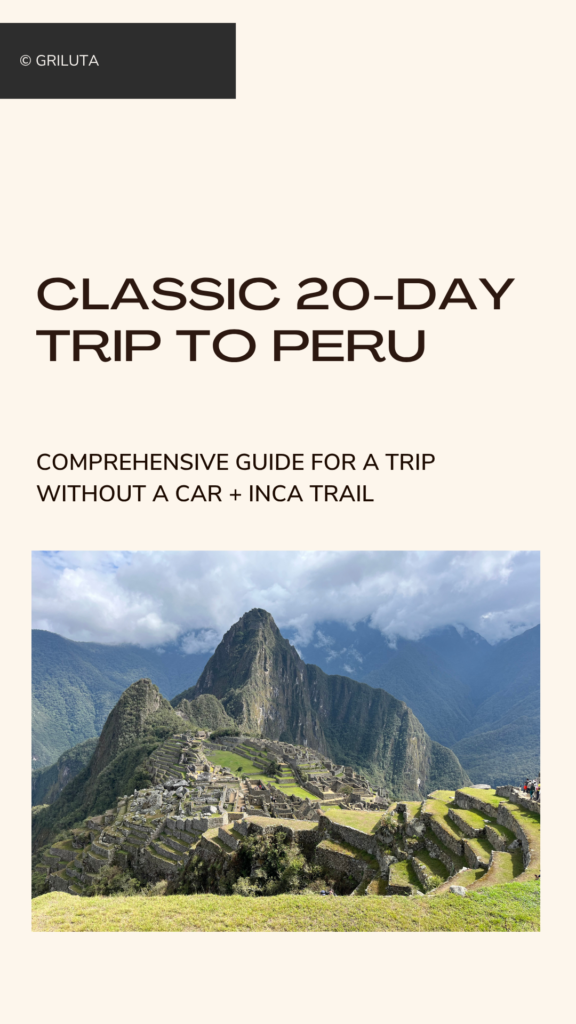
Travel Without Chaos: Peru — Classic 20-Day Itinerary Without a Car (+ Inca Trail)
Classic 20-Day Trip to Peru — Complete PDF Guide