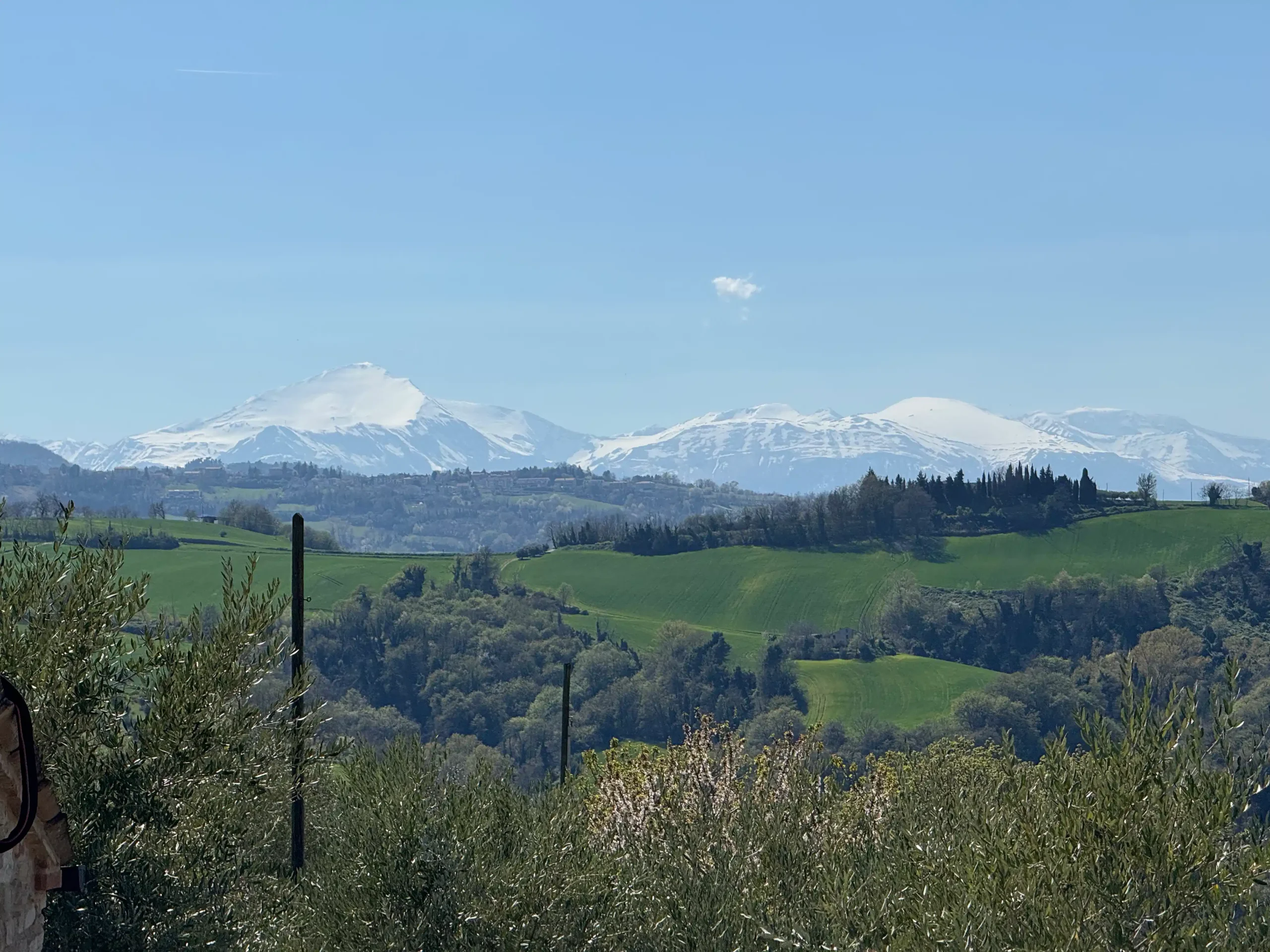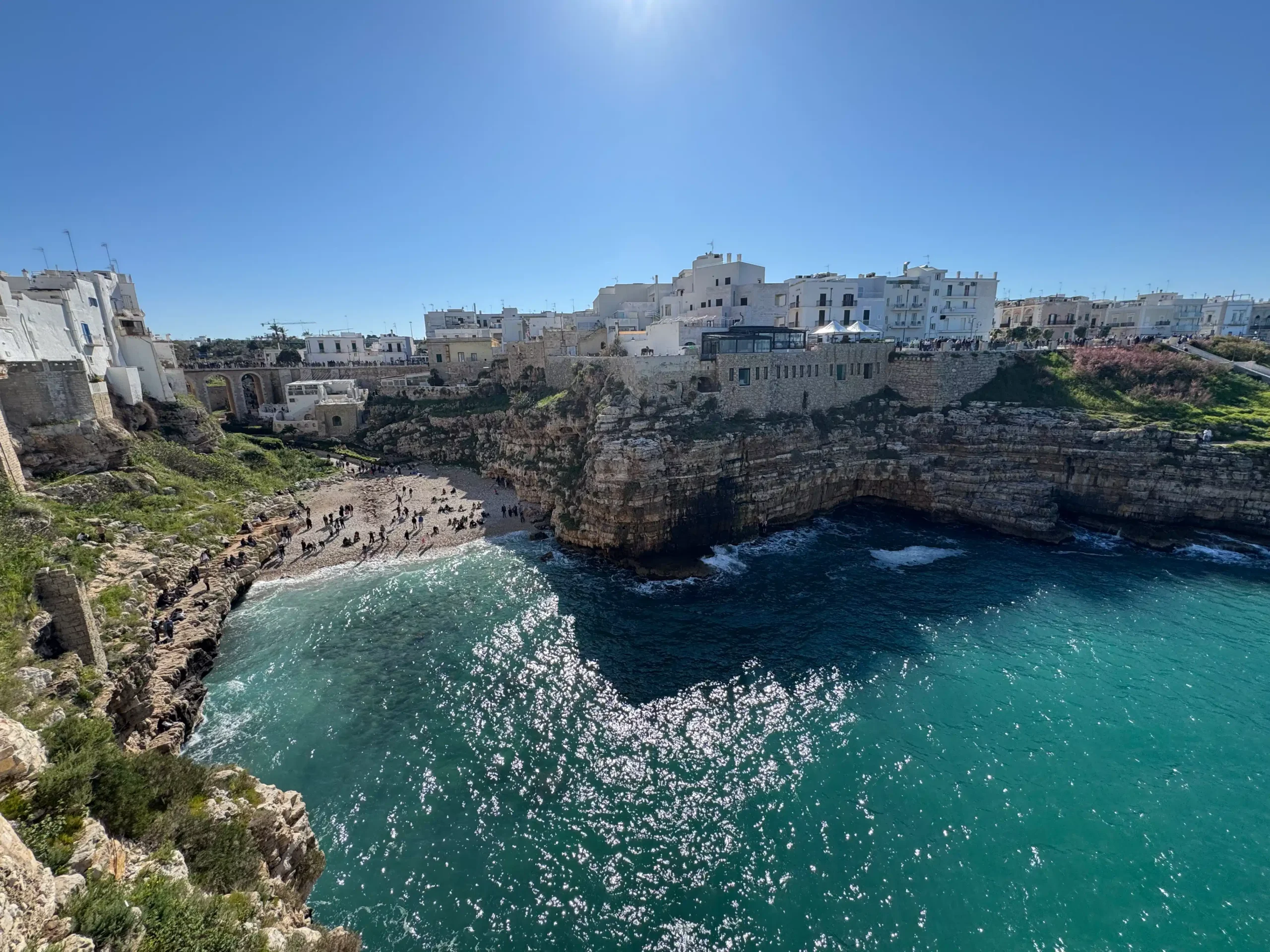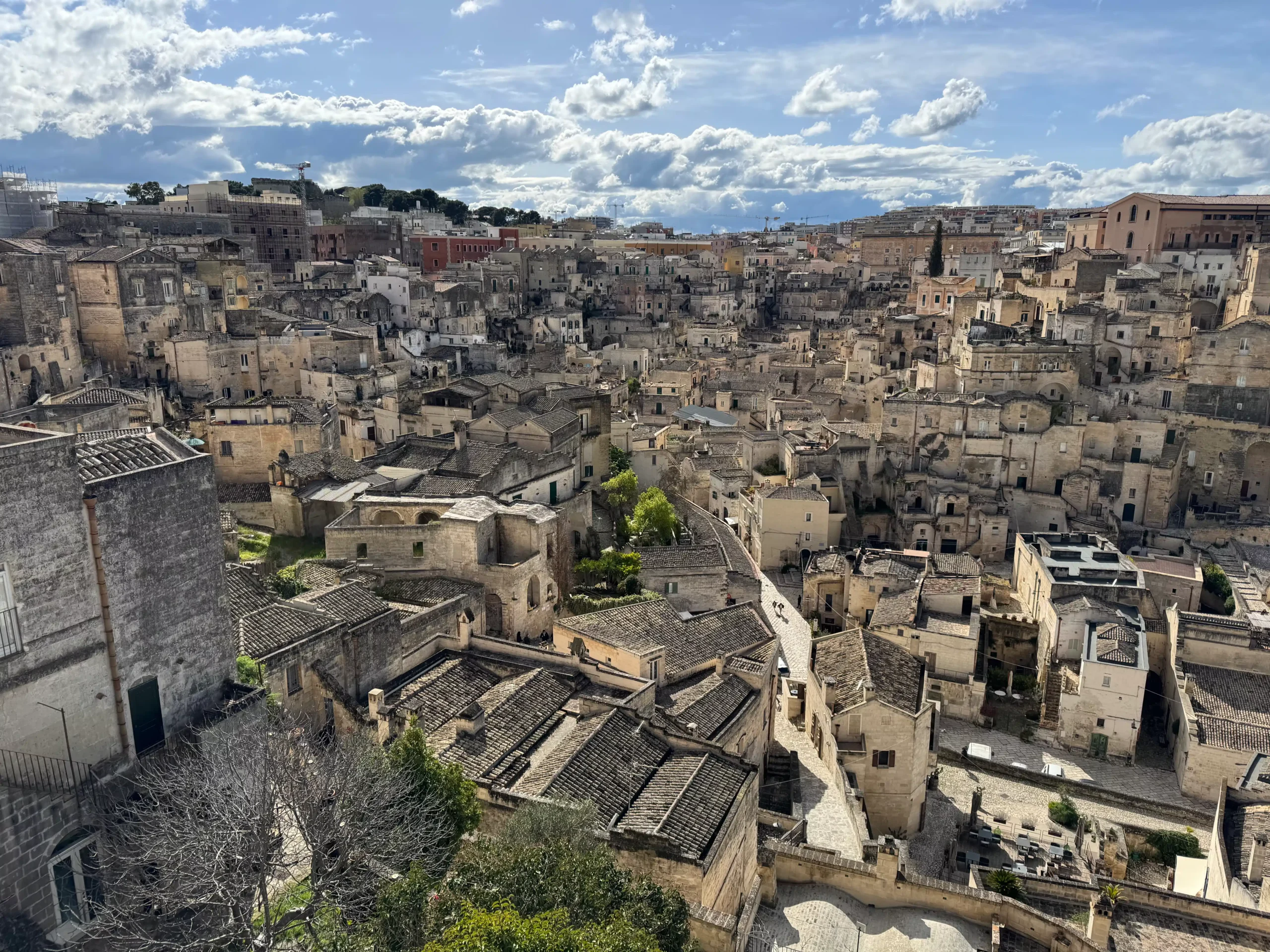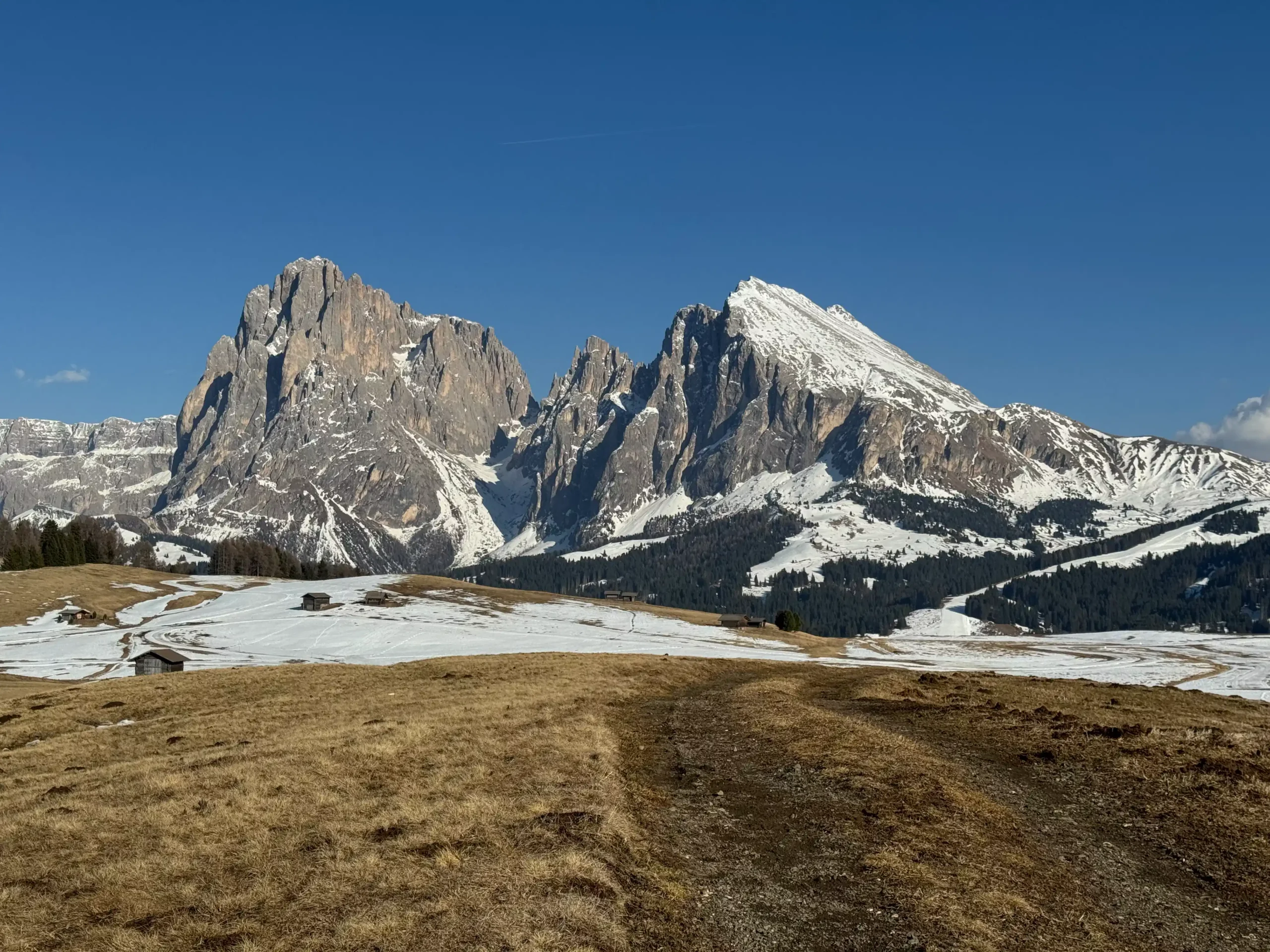
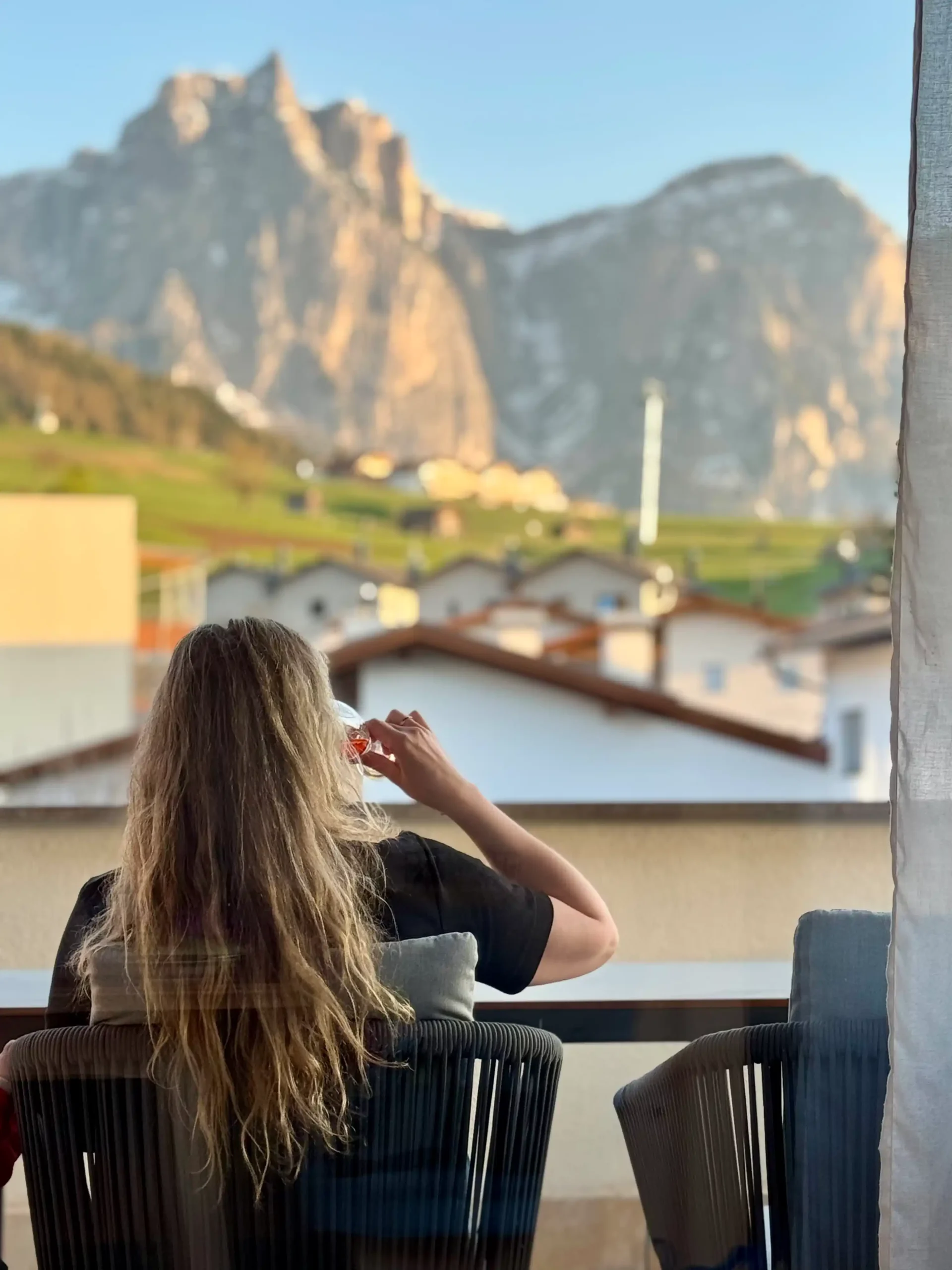
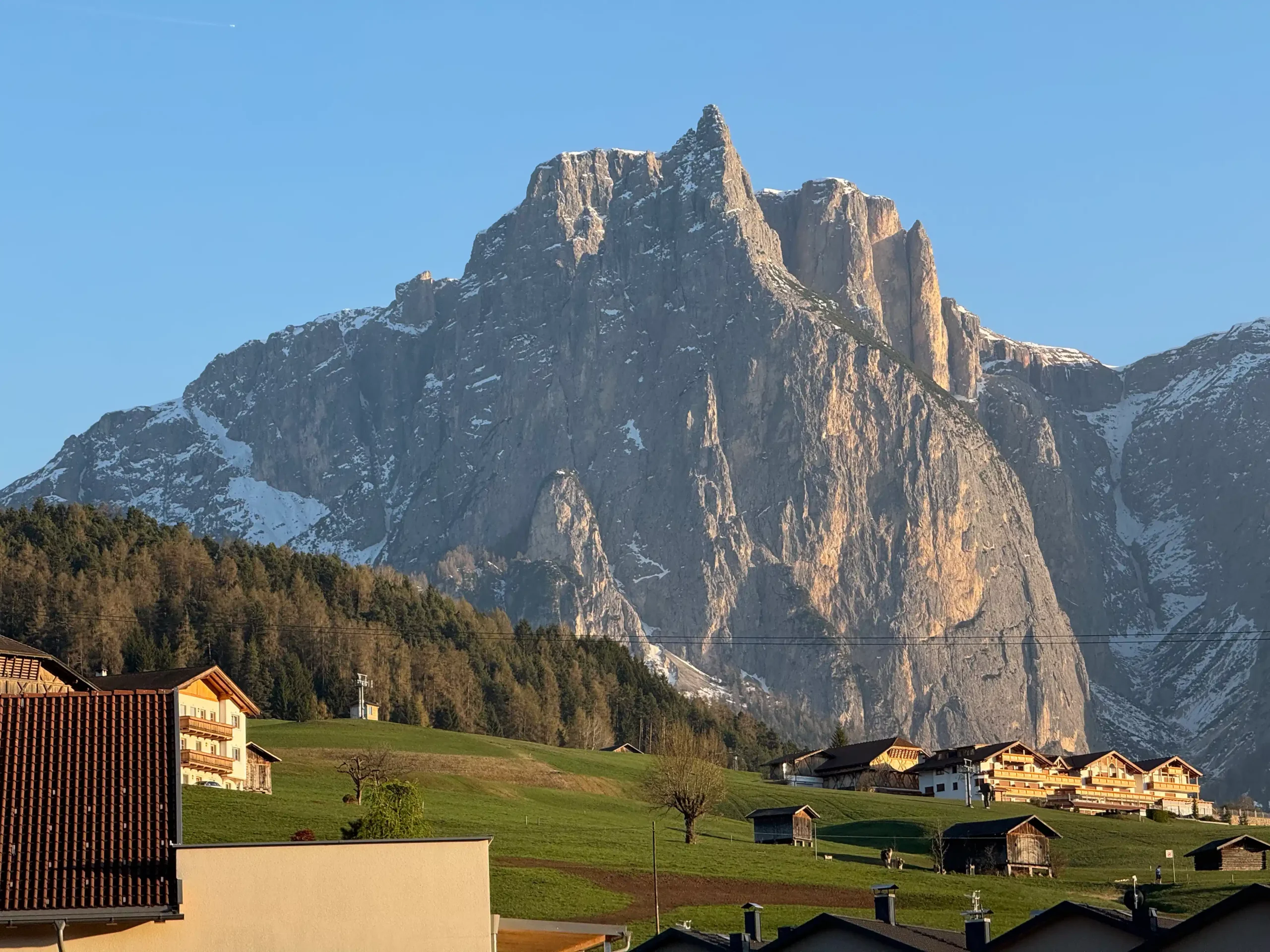
I’m standing on the apartment terrace and below me is the old town of Castelrotto with its red roofs and white houses. Right in front, maybe two kilometres away, rises Sciliar (the Germans say Schlern) – a rock mountain with two peaks, like two teeth set into the sky. The sun is beating down so much that I checked my phone three times: is it really mid-April, or did I lose a day somewhere? I hold my coffee, look at the Sciliar bell tower in the town centre, and in my mind send my husband the same word he said when we arrived: wow.
Some links in this article are affiliate links. If you book through them I earn a small commission, at no extra cost to you.
Contents
- Why mid-April is the best time for Castelrotto
- Day 1: the road from the Marche to the Dolomites
- First impression of the Dolomites
- An apartment in the very centre of Castelrotto
- The town of Castelrotto: what we saw
- The bell tower: the tallest in South Tyrol
- Piazza Kraus: the heart of the town
- Walking trails around
- German-Italian culture
- Day 2: the Alpe di Siusi plateau
- How we drove up
- Compatsch and the plateau
- Lunch up high
- Day 3: a quieter rhythm around Castelrotto
- A morning walk
- Bolzano: is it worth going?
- Day 4: the journey home across half of Europe
- The route
- Practical information for a cross-border journey
- Practical information
- Accommodation price guide
- With a baby in the Dolomites
- Is it worth going? My opinion
- FAQ: frequently asked questions
This is Castelrotto (in German Kastelruth), a small South Tyrol town at the foot of the Dolomites, about 1,060 m above sea level. Between Bolzano and Val Gardena, by Europe’s largest mountain plateau, Alpe di Siusi (in German Seiser Alm). A place where all the signs are in two languages – Italian and German, where the waiter greets you with “Grüß Gott” rather than “Buongiorno”, and where strudel, speck and knödel are more natural than pasta.
This was the last stop on our month-long journey through Italy. Three nights, two full days, mid-April. And, as I’d guessed, one of the best parts of the whole trip.
This article is part of our month-in-Italy story. We came to Castelrotto from Sant’Elpidio Morico in the Marche hills. Earlier we stayed in Salerno, Tuscany’s Chianti, Sperlonga, Gravina in Puglia, Torre Santa Sabina and Venice.
Why mid-April is the best time for Castelrotto
I’ll start with what I learned after the fact, and what changed the character of this trip. Mid-April in South Tyrol is the so-called Zwischensaison – the between-season. The winter season is over (the ski slopes are closed), and the summer season hasn’t yet begun (the lifts open around 20–25 May).
Specifically:
| Thing | Winter season | Between-season (mid-April – mid-May) | Summer season |
|---|---|---|---|
| Alpe di Siusi lift | Running | Closed | Running |
| Road to Compatsch | Open only to hotel guests | Open to all, all day | Closed 9–17 (lifts only) |
| P2 Compatsch parking | – | €14/day | €30/day |
| Apartment prices | High | Lowest | Max (up to €500/night in summer) |
| Restaurants | Most open | About half closed | All open |
| Tourists | Many (skiers) | Almost none | Full |
In our case that meant: the road to the plateau open all day, cheaper parking, apartments at €100 instead of €500 in summer, almost no tourists. But: the lifts don’t run (Seceda, Ortisei – closed until 22 May), half the restaurants are closed, some trails still have snow.
Is that bad? For us – no. On the contrary, the fact that on the hill we were met by an almost empty plateau instead of a crowd of tourists became one of the best opening parts. But if you want to ride the lifts, visit all the rifugi and see the Dolomites with spring flowers, mid-April is a little too early. The best compromise: early June or late September.
Day 1: the road from the Marche to the Dolomites
From Sant’Elpidio Morico we left early, around 6 a.m. The aim was to reach Castelrotto during the day, while the child was still sleepy. The road is about 700 km, 7–8 h with one breakfast stop. The route:
- Sant’Elpidio Morico → the A14 by San Benedetto del Tronto (50 km)
- The A14 north to Bologna (360 km)
- The A1 → A22 (Brennero motorway) to Bolzano (250 km)
- The SS12 → SP24 to Castelrotto (30 km)
The whole journey was simply motorway. We stopped only once, around 11 a.m. at an autogrill station: espresso, a cornetto, a sandwich. About €15 in total.
Road tolls:
- The A14 (Sant’Elpidio Morico → Bologna): about €25
- The A1 (Bologna → Verona): about €12
- The A22 Brennero (Verona → Bolzano): about €13
- Total: about €50
For fuel – another €80 or so for a full tank. The journey cost about €130.
First impression of the Dolomites
Passing Trento and approaching Bolzano, the mountains begin to rise into the sky as if from nowhere. The first “wow” moment is on the Brennero motorway, when you first see the snowy peaks. This is the Trentino-Alto Adige (South Tyrol) region, where the Italian world ends and another begins: German, Austrian, mountain.
On the day of our arrival the weather was +18°C and sunny. No snow anywhere along the way. We reached Castelrotto around 2 p.m.
An apartment in the very centre of Castelrotto
I found the accommodation through Booking. An apartment in the town of Castelrotto itself, about €110 a night. One separate bedroom, a little kitchen, a bathroom, and a huge terrace with a view of the mountains.
Tip: when you book Castelrotto in the between-season, check whether the hosts of the apartment you’ve chosen are still working. Some close during the April break.
An apartment in the town itself has one big plus: Castelrotto is so small that everything is reachable within ten minutes on foot.
The town of Castelrotto: what we saw
Castelrotto is not just a base. It’s a town with character. About 1,060 m above sea level, home to around 6,500 people, its name first documented between 982 and 987 as Castelruptum. The German name Kastelruth also fits, and the locals use it most often.
The bell tower: the tallest in South Tyrol
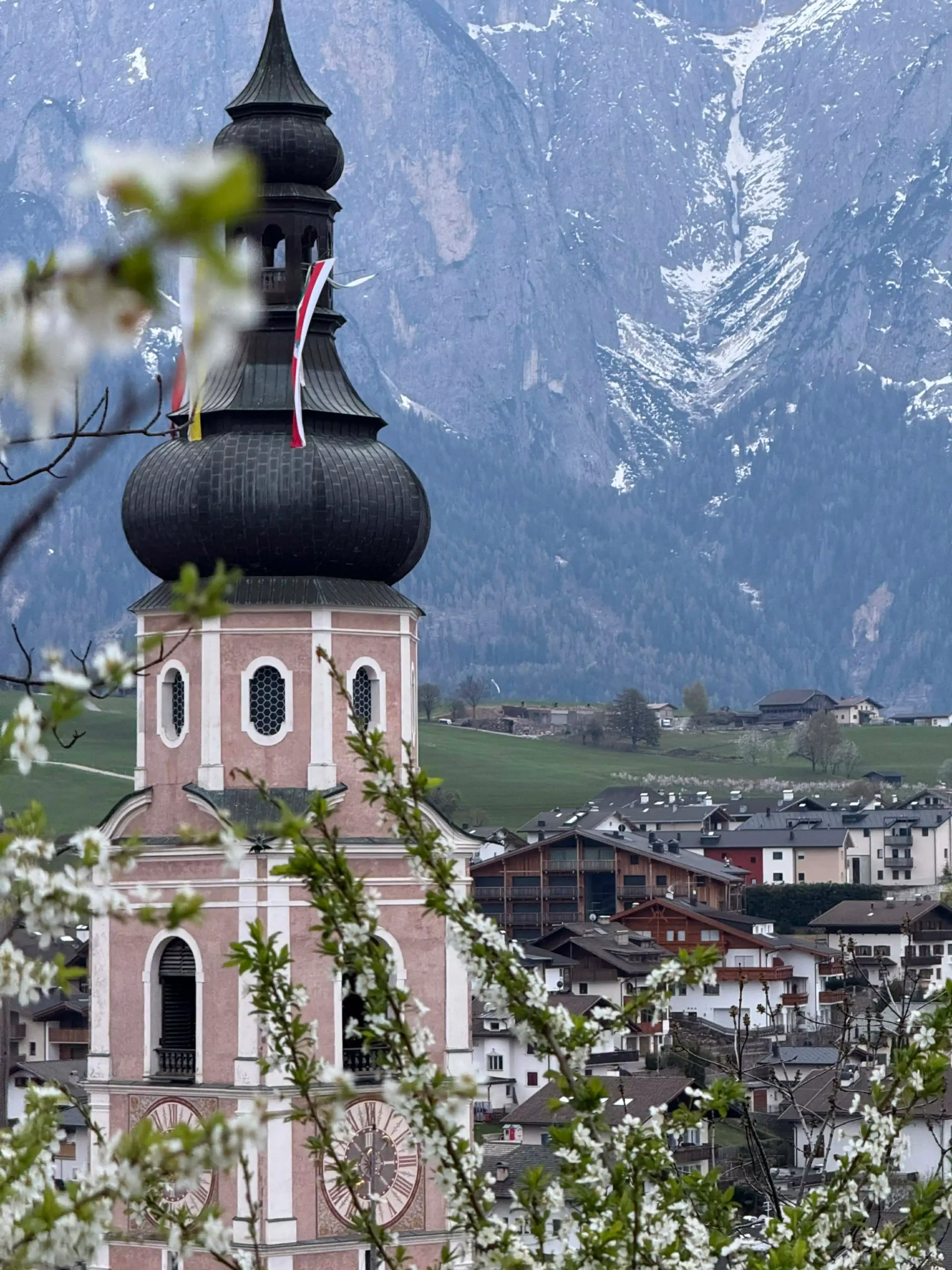
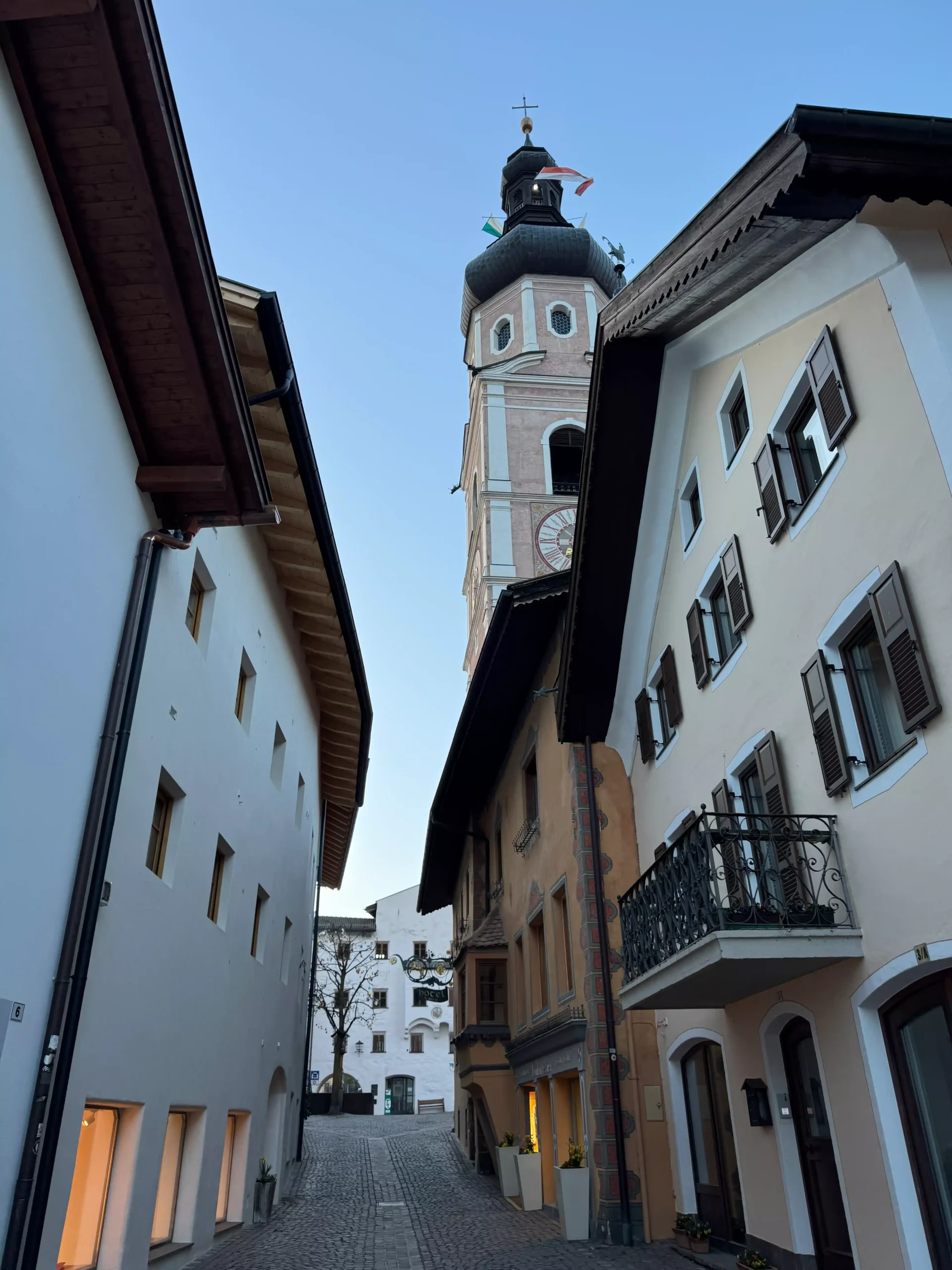
Castelrotto’s bell tower stands in the middle of the town, by the parish church of Saints Peter and Paul. 82 metres tall. The tallest in all of South Tyrol, called “the cathedral of the Dolomites”, although the church itself is quite small.
The history is interesting: an older church with a small tower burned down in a fire in 1753. After it, the locals decided – if we’re building a new one, let it be tall. They made the new tower so large that it now looks disproportionate compared to the size of the town. But that’s exactly why it sticks in the memory: you see it from any lane in the town, from the fields around, even from the Alpe di Siusi plateau above the clouds.
The tower is open to visitors – you can climb it with a guide. We didn’t climb, because with a baby in a pushchair 250 steps is impossible, but if you’re travelling without children – it’s definitely worth it.
Piazza Kraus: the heart of the town
Krausplatz (in Italian Piazza Kraus) is the tiny central square by the bell tower. Around it – cafés, restaurants, the Cavallino d’Oro hotel (in operation since 1326, yes, more than 700 years). The façades of the apartment buildings are covered with flower frescoes and German phrases: “Gott segne dieses Haus” (“God bless this house”), “Anno 1612”, and the like.
Walking trails around
Castelrotto has many marked walking trails around the town, suitable for families with pushchairs. The trails are marked with numbers and directions (“Spaziergang” – a stroll, “Wanderweg” – a hill trail).
We walked the “Calvarienberg” (Calvary Hill) trail – a small climb up to a chapel above the town, with Stations of the Cross stones along the way. About 30 minutes of easy climbing, good with a pushchair. From the top – a panorama of Castelrotto with Sciliar behind. Thanks to that view I now know what a postcard view means.
German-Italian culture
South Tyrol belonged to the Austrian Empire until the First World War. After it, the 1919 Treaty of Saint-Germain gave the region to Italy. Today three language groups live here: the German (about 70%), the Italian (about 25%) and the Ladin (a minority – about 5%, speaking Ladin, made up of a Latin base with Germanic and Slavic admixtures).
In practice that means:
- All the signs are in two (sometimes three) languages
- The restaurant menus are bilingual
- The waiters greet you with “Grüß Gott” (a German greeting) more often than with “Buongiorno”
- The architecture: wooden balconies, frescoes by the windows – completely Austrian
Day 2: the Alpe di Siusi plateau
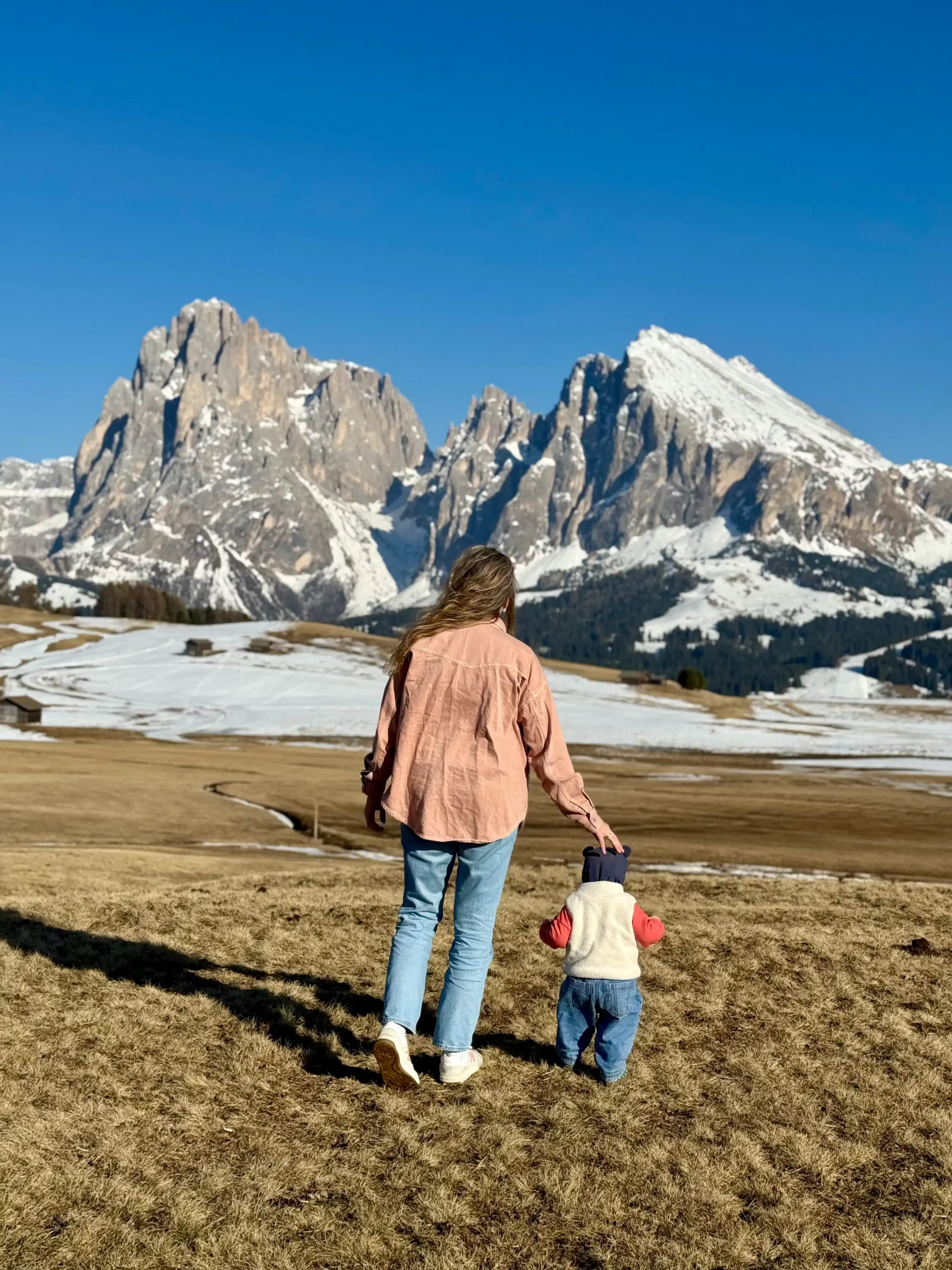
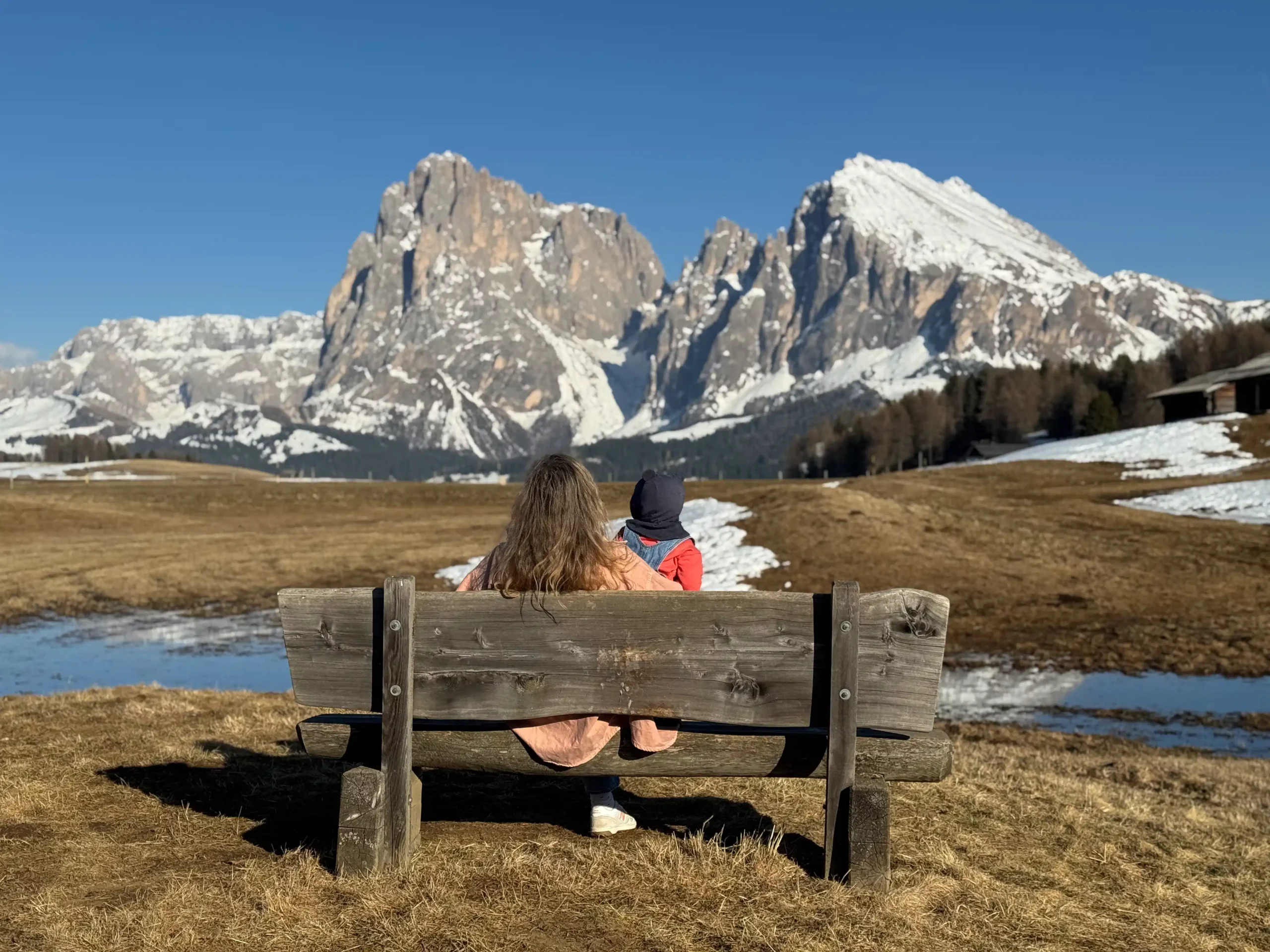
This is the day people come to Castelrotto for. Alpe di Siusi (Seiser Alm) is Europe’s largest mountain plateau: 56 km². It sits at 1,800–2,200 m, surrounded by the Sciliar, Sassolungo and Sasso Piatto mountains. In summer – green grass and cowbells. In winter – a white skiing paradise. Mid-April is somewhere in between, there are still patches of snow, but the grass is already showing.
How we drove up
In summer the Alpe di Siusi road is closed to private cars from 9:00 to 17:00. You have to take the lift from Siusi (Seis), or the bus. In mid-April, when the lift is closed for the between-season, the road is open to cars all day. And that was one of our best circumstances.
The route: Castelrotto → Siusi (Seis) → the SP24 towards Compatsch. The road is narrow but paved, with a few climbing bends and views down to the Isarco valley. 15 km, 30 min at an average speed.
The P2 Compatsch parking is open to all in mid-April, a daily fee of €14 (€30 in summer).
Compatsch and the plateau
Compatsch (in Italian Compaccio) is the main settlement on the plateau, at 1,850 m. A couple of hotels, restaurants, a sports-equipment shop, the top station of the lift. A typical mountain resort, but very small.
We spent the whole first afternoon here. With a pushchair. That’s important to note – up high, on the plateau, the road is flat, it looks like a park. The marked trails are passable with a pushchair. The Hans und Paula Steger Weg is the most popular flat trail, about 4 km in one loop, with panoramas of the Sciliar, Sassolungo and Schlern mountains.
There were patches of snow, but not on the trails. The cows weren’t there yet (they’re let out onto the plateau at the end of May). But already there were:
- The first yellow flowers (Soldanella and crocus, alpine flowers that bloom almost straight from the melting snow)
- A blue sky without clouds, with the peaks of Sassolungo
- Complete silence, except for the occasional bell, when somewhere on a distant farm someone calls a cow
- About 12°C, not cold, not hot, ideal
Lunch up high
The restaurant in Compatsch – Lanzin Stube. German-Tyrolean, one of the few open in mid-April.
- Tyrolean Knödel with speck and parmesan – €12
- Cheese Spätzle – €10
- Apfelstrudel (apple pie with vanilla sauce) – €6
- Two Forst beers – €8
About €40 in total for two people.
Day 3: a quieter rhythm around Castelrotto
On the third day we decided to do nothing big. The fact that the journey home would be two thousand kilometres over two days said: yesterday we drove up to the plateau, today we relax.
A morning walk
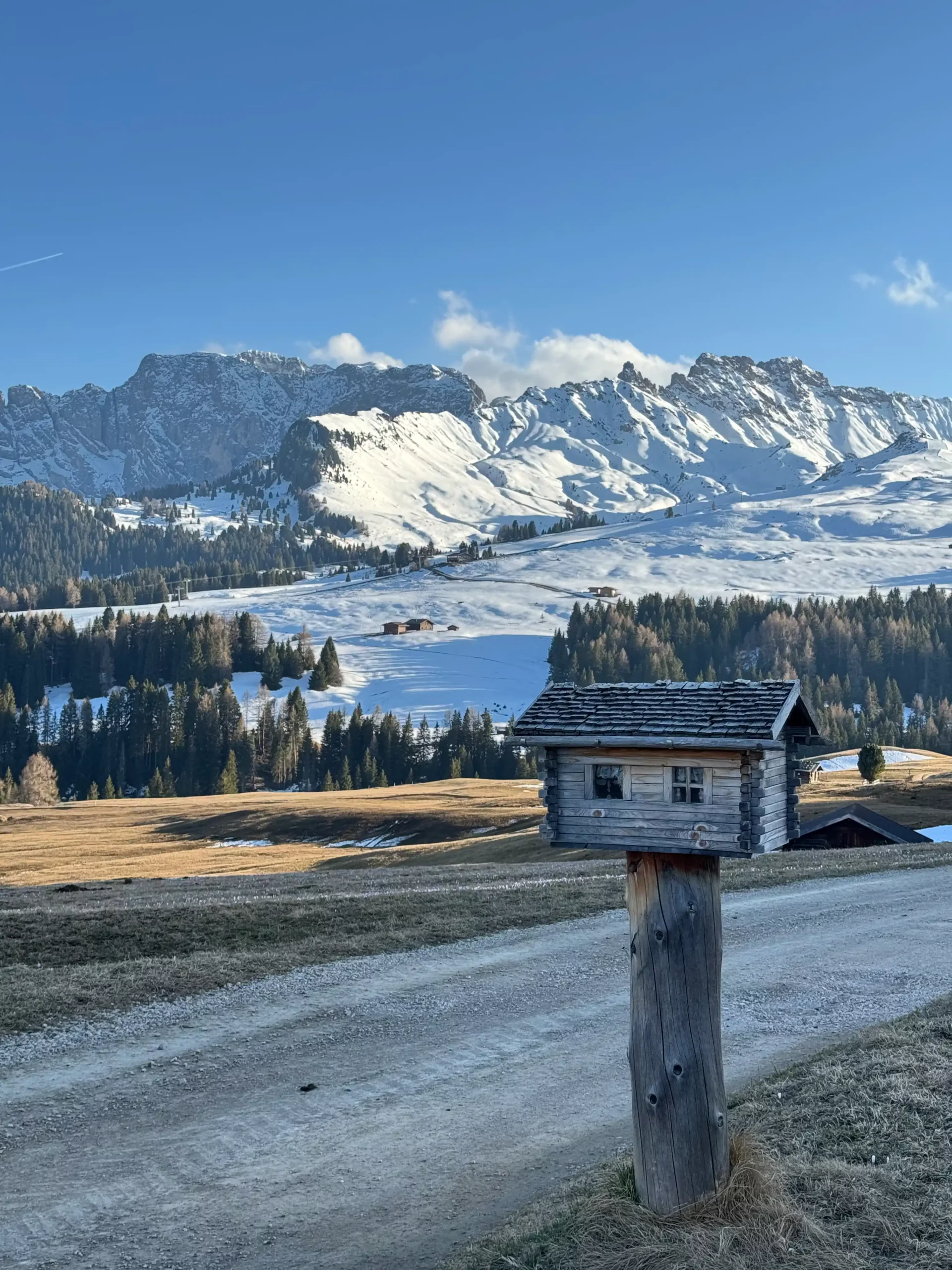
Around Castelrotto there are meadow and alpine-farm trails you can walk with a pushchair or a carrier. We chose the “Oswald von Wolkenstein” trail – named in honour of a medieval minstrel born in these parts in the 15th century. A walk among farms and farming hamlets (called “Höfe”), where large families still live and keep cattle, make cheese and farm.
Bolzano: is it worth going?
Bolzano (in German Bozen) is the capital of South Tyrol, 30 km from Castelrotto, 35 min by car. In it are:
- The old town with Piazza Walther, German signs, Austrian porticoes
- The Museo Archeologico – home to Ötzi, the famous glacier mummy, found in the Alps in 1991, 5,300 years old.
- The Duomo (the Cathedral of Mary) – Gothic, with a green mosaic roof
Day 4: the journey home across half of Europe
Frankly: this was the daunting part of the trip. 2,000 km from Castelrotto home, with a 1-year-old in the car, through Germany, Austria and Poland. But we had a plan: two days, with an overnight stay in Poland.
The route
- Castelrotto → the Brenner Pass → Innsbruck (about 130 km, 2 h). Via the Brennero (Brenner Pass, 1,370 m) – the Italy-Austria border. The distances on this stretch on both sides: on the Italian side about €7 (we were already on the A22), on the Austrian side – a 10-day vignette is needed, about €12.
- Innsbruck → Germany → Nuremberg (about 350 km, 3.5 h). Across the edge of Austria, crossing the border into Germany. The German motorways are free, but with a lot of traffic.
- Nuremberg → Dresden → the Polish border (about 450 km, 4.5 h).
- The first overnight: somewhere in Poland, about 100 km past the German border.
First day: about 950 km, about 10–11 h with stops.
Practical information for a cross-border journey
Here are the things I wanted to know before setting off:
| Matter | Cost / detail |
|---|---|
| Austrian vignette (10 days) | about €12, buy at the border or online |
| Slovenian vignette (if you take that route) | about €16 |
| German motorways | free |
| Polish motorways (toll sections) | about €20–30 per stretch |
| Fuel (the whole journey home) | about €250 with a full tank in Castelrotto |
| Overnight in Poland (a hotel on the way) | about €70–100 a night for a family |
The second day’s road: Wrocław → Warsaw → the Suwałki corridor → home. About 700 km, 8 h.
Practical information
| Category | Detail |
|---|---|
| Best months | The second half of June, September; for winter – January–February |
| Between-season | Mid-April – mid-May, late November – early December |
| Alpe di Siusi lift | Summer: 21 May – 1 November (2026) |
| Alpe di Siusi road for cars | Open all day only in the between-season |
| Payment | Cards everywhere, but bring cash to buy produce from farmers |
| Cot (Kinderbett) | Always ask in advance |
| Pushchair vs. carrier | In Castelrotto centre – a pushchair is fine. On the Alpe di Siusi trails – a pushchair |
| Warm clothes | Even in April (on the plateau it can be 8–12°C, an evening wind) |
Accommodation price guide
- Castelrotto centre (apartments): €90–150 in the between-season, €200–500 in summer
- Alpe di Siusi (Compatsch): from €200 in the between-season, up to €700 in summer
- Bolzano: €100–180 in all seasons
With a baby in the Dolomites
A short checklist:
- Apartments are better than a hotel – with a little kitchen
- A pushchair is suitable for the plateau trails (gravel road)
- An altitude up to 1,850 m is safe for a baby without special acclimatisation
- A thin jacket is enough in April if the weather is good (+15–25°C)
- Remember that in mid-April half the restaurants and lifts are closed
Is it worth going? My opinion
Short answer: loved it. The longer one:
It’s worth it if you want to see a different side of Italy. Not pasta, not the coast, not the southern atmosphere, but high mountains, German culture, strudel with vanilla sauce, people who speak two languages every day. This is Italy, but not the one you expect.
It’s worth it if you’re travelling with small children and want a place where everything is well arranged: good roads, marked trails, restaurants welcoming to children, clean air.
It’s worth it if you choose a between-season month. Mid-April, late April, early May – the cheapest time, the fewest tourists. But you understand that the lifts and half the restaurants are closed.
It’s not worth it if skiing matters more to you (the winter is over) or if you want the full mountain programme with all the lifts. Then come in summer.
Three nights was enough – one full plateau day, one free. But if we had the freedom, I’d stay five nights, adding the Seceda, Ortisei lift (if in season), and one day in Bolzano with the Ötzi museum.
Our mistake: we didn’t visit the Funes / Villnöss valley with the famous San Giovanni in Ranui chapel. It’s only 50 km from Castelrotto.
Of our whole month-in-Italy journey, which led through Salerno, Tuscany’s Chianti, Sperlonga, Gravina in Puglia, Torre Santa Sabina, Sant’Elpidio Morico and Venice, Castelrotto remained the best final chord. Tuscany is Italy. Puglia is Italy. Castelrotto is something else – Italy with a German accent, with mountains that look as if someone cut them out of a fairy tale.
FAQ: frequently asked questions
Can you reach Castelrotto without a car? You can. From Bolzano (which has a train station) there’s bus No. 170, the journey takes about 50 min and costs about €4. But around the town – Alpe di Siusi, Bolzano, Funes – it’s much harder without a car. Especially with a small child.
Is Castelrotto suitable for families with small children? Very. The town is small, safe, with lots of families. Many hotels have children’s rooms, playgrounds, bikes to ride. The locals interact warmly with children.
What are the prices in South Tyrol compared with the rest of Italy? Among the most expensive in Italy. Dinner for one person in a restaurant is about €25–35 without drinks. Breakfast about €8–12. An espresso €1.30–1.80. But the prices are justified by the quality: everything is well made, clean.
Are there ski slopes in summer? Until early April. After that – only high up above 2,800 m (for example, the Stelvio Pass). In summer Castelrotto and Alpe di Siusi are a hiking kingdom, not a skiing one.
Does everything work in April–May? No. From mid-April to mid-May is the Zwischensaison (between-season). Most of the lifts don’t run, about half the restaurants are closed, but the surroundings are quieter, and the road to Alpe di Siusi is open to cars all day – which is a big plus.
Is it worth going to Bolzano on a day trip? If you’re interested in the Ötzi mummy or city culture – it’s worth it. If you’re not – stay up high. Bolzano is a small city, pretty, but not special. The heights of the Dolomites are the real gem.
Are 3 nights in Castelrotto enough? They’re enough to see the main things: the town of Castelrotto, Alpe di Siusi, one of the neighbouring towns; but if you want to see Seceda, Ortisei, the Funes valley, Lago di Carezza, and several Dolomite passes (Sella, Gardena, Pordoi) – you need five nights and the summer season.
Find flights here. If something goes wrong with your flight, you can claim compensation via AirHelp or Compensair.
Staying connected? Skip expensive roaming and grab an eSIM plan — set it up before you fly and you’ll have data the moment you land.
I always recommend booking airport transfers in advance. You can do that here.
Find accommodation here.